

THE URBAN INDIAN AGENDA (UIA) “Recognition Before Representation”

Updated: Oct 19

WHAT IS AN URBAN INDIAN?
An Urban Indian is an Indigenous descendant living outside reservation or tribal land systems, often within metropolitan areas, whose lineage, ancestry, cultural continuity, or historical identity traces to the original Indigenous peoples of the Americas.
Today, more than 70% of American Indians and Alaska Natives live in urban areas, making Urban Indians the majority demographic reality of Indigenous life in the United States. National Council of Urban Indian Health
The Urban Indian Agenda recognizes that Indigenous existence does not end at reservation boundaries, nor can Indigenous identity be reduced solely to federal enrollment systems.
The Urban Indian Agenda (UIA) is a policy and civil rights framework developed to address the historical and ongoing exclusion, misclassification, and administrative erasure of Urban Indians and detribalized Indigenous descendants throughout the United States.
For generations, many Indigenous peoples particularly those of Black Indigenous lineage were absorbed into externally imposed racial categories such as “Negro,” “Colored,” “Mulatto,” and later “Black” through census policies, state record systems, segregation laws, boarding schools, urban relocation policies, and institutional practices. These processes disconnected millions from recognized Indigenous identity, community protections, federal resources, historical acknowledgement, and cultural continuity.
The UIA asserts that:
Indigenous identity cannot be erased through administrative paperwork.
Tribal enrollment is not the sole determinant of Indigenous lineage or Indigenous existence.
Urban Indians deserve recognition, representation, access, remedy, and restoration.
Political support must be tied to measurable commitments and actionable policy outcomes.
This agenda exists to restore visibility to historically invisible Indigenous descendants and to establish a pathway toward cultural, legal, economic, educational, and historical justice.
HISTORICAL BACKGROUND
The history of Urban Indians in the United States is deeply tied to colonization, forced migration, slavery, detribalization, racial reclassification, segregation, and federal relocation policies.
Throughout American history:
Indigenous peoples were the first enslaved and alongside Africans later.
Many tribes intermarried and merged with African-descended populations.
State governments frequently altered racial designations on birth records, census documents, and legal classifications.
Indigenous peoples living outside federally recognized tribal systems were increasingly absorbed into generalized racial categories.
During the 20th century:
Urban relocation programs pushed Indigenous populations into major cities.
Urban renewal policies displaced Indigenous and minority neighborhoods.
Civil rights era racial frameworks often collapsed distinct Indigenous populations into broader “Black” categories.
Administrative systems increasingly tied Indigenous recognition exclusively to federal tribal enrollment.
These processes created generations of Urban Indians descendants of Indigenous peoples living outside reservation systems who often retained family memory, cultural continuity, oral histories, and genealogical evidence despite lacking formal recognition pathways.
The UIA recognizes these communities as part of the continuing Indigenous reality of America.
Urban Indians may include:
detribalized Indigenous descendants
Indigenous Freedmen descendants
Black Indigenous communities
historically reclassified Indigenous populations
mixed-lineage Indigenous descendants
Indigenous families affected by forced migration or relocation
descendants excluded from federal recognition systems
The UIA rejects the false assumption that Indigenous existence is limited only to federally recognized tribal enrollment systems.
Urban Indians are not “new identities.”
They are descendants of historical realities.
THE CRISIS OF MISCLASSIFICATION
For centuries, Indigenous peoples in America were systematically reclassified through governmental, institutional, and social systems.
This included:
census racial reassignment
altered birth records
segregated school designations
“Colored” and “Negro” reclassification
state registrar racial changes
exclusion from Indigenous rolls
forced assimilation policies
administrative detribalization
The result was:
cultural disruption
loss of language
denial of Indigenous identity
exclusion from federal protections
historical invisibility
genealogical confusion
political disenfranchisement
The UIA identifies this process as a form of administrative erasure that requires formal review and remedy.
STATISTICAL & HISTORICAL EVIDENCE
The Urban Indian population is one of the fastest growing Indigenous populations in the United States.
Federal data already confirms:
the majority of Indigenous people now live in urban areas
millions identify as American Indian or Alaska Native
mixed-race Indigenous identification continues to rise
many families possess documented Indigenous ancestry outside formal enrollment systems
Historical records additionally demonstrate:
Indigenous slavery in colonial America
“Black Indian” census terminology
Indigenous Freedmen populations
racial recoding practices
Indian migration into segregated urban communities
state-level racial reassignment policies
The UIA calls for a full national historical review into the administrative correcting of Indigenous peoples throughout American history.
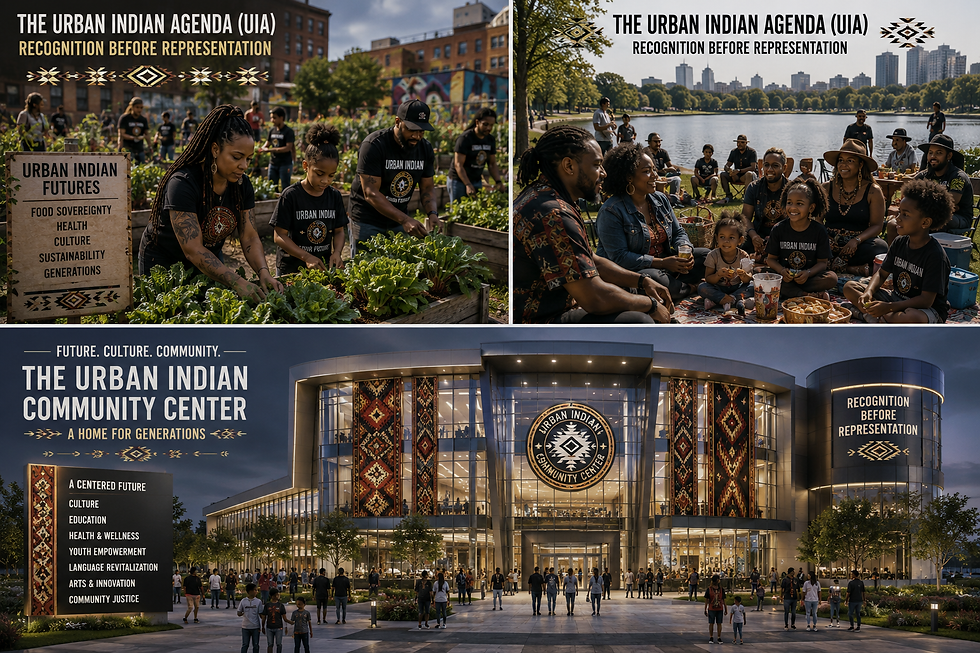
CORE PRINCIPLES
1. Recognition
Urban Indians deserve acknowledgement as legitimate Indigenous descendant communities.
2. Restoration
Communities affected by historical erasure deserve cultural and historical restoration pathways.
3. Representation
Urban Indians must have direct representation in policies affecting Indigenous peoples.
4. Inclusion
Federal and state Indigenous programs must include Urban Indian populations.
5. Remedy
Historical harms require measurable corrective action.
6. Accountability
Institutions responsible for exclusion and misclassification must be reviewed publicly.
7. Self-Identification
Indigenous identity cannot be reduced solely to administrative enrollment systems.
THE 20 DEMANDS
1. Congressional Investigation into Indigenous Misclassification
2. Federal Urban Indian Recognition Commission
3. Revision of Federal and State Indigenous Definitions
4. Protection Against Administrative Ethnonullification
5. Guaranteed Access to Urban Indian Health Programs
6. Historical Trauma & Identity Restoration Services
7. Urban Indian Housing & Anti-Displacement Initiatives
8. Mandatory Inclusion of Urban Indian History in Education
9. National Indigenous Archive Recovery Project
10. Federally Funded Genealogical Assistance Programs
11. Urban Indian Economic Development Fund
12. Inclusion in Federal Procurement & Diversity Programs
13. DOJ Civil Rights Review of Misclassification Practices
14. Media & Academic Representation Standards
15. Urban Indian Federal Advisory Councils
16. Mandatory Urban Indian Representation in Policy Discussions
17. Access to Indigenous Artifacts & Historical Records
18. Inclusion in Federal Repatriation Processes
19. Federal Urban Indigenous Language Revitalization Funding
20. Federally Supported Black Indigenous Urban Community Centers
PETITION DEMANDS
The UIA incorporates the demands expressed by thousands of signatories seeking remedy for historically misclassified Indigenous peoples.
These demands include:
formal acknowledgement of misclassified Indigenous descendants
investigation into racial reassignment policies
inclusion of Urban Indians within Indigenous policy discussions
historical review of administrative detribalization
protection from identity erasure
expanded access to Indigenous services
recognition that enrollment is not the sole measure of Indigenous lineage
Congressional hearings regarding Indigenous misclassification history
Petition support demonstrates that this issue affects thousands of families seeking historical truth, cultural restoration, and institutional accountability.

LEGISLATIVE PRIORITIES
The UIA supports:
federal hearings on Indigenous misclassification
Urban Indian inclusion legislation
Indigenous language preservation grants
cultural restoration funding
census policy review
archival transparency laws
repatriation reform
urban Indigenous health expansion
anti-discrimination protections for detribalized Indigenous descendants
educational curriculum reform
The UIA further calls upon:
Congress
state legislatures
civil rights organizations
Indigenous advocacy institutions
universities
museums
federal agencies
to formally address the historical exclusion of Urban Indians.
ACCOUNTABILITY STANDARDS
The Urban Indian Agenda rejects symbolic recognition without measurable action.
Support for political candidates, institutions, organizations, or coalitions should be contingent upon:
written policy commitments
measurable implementation timelines
funding allocations
public reporting requirements
Urban Indian representation in decision-making spaces
The UIA maintains:
No recognition without accountability.
No representation without inclusion.
No support without measurable commitments.
CLOSING DECLARATION
Urban Indians are not invisible. Urban Indians are not extinct. Urban Indians are not administrative errors.
They are descendants of the First Peoples of this land communities who survived colonization, slavery, segregation, displacement, and reclassification while carrying fragments of memory, culture, ancestry, and identity across generations.
The Urban Indian Agenda exists because recognition delayed is justice denied.
This movement is not about division. It is about restoration.
It is about acknowledging that entire Indigenous populations were absorbed into racial systems that often erased their distinct origins while benefiting institutions that spoke on their behalf without informed consent.
The United States cannot fully address Indigenous justice while ignoring the millions of Indigenous descendants living beyond reservation boundaries and outside federally recognized enrollment systems.
The first peoples of this land cannot be administratively erased.
The Urban Indian Agenda calls for:
truth
remedy
restoration
recognition
representation
and accountability
for Urban Indians and historically misclassified Indigenous descendants throughout America.
FIRST TRIBE


Comments