

A Historic Milestone for Indigenous West Florida , Louisiana

Updated: Sep 10
Chief Warhorse The Bonfouca Museum Resolution, State Recognition, and an Indigenous Vision for the Future
By Ishmael A. Bey

History is often measured by the moments when governments choose not only to preserve the past but to publicly recognize it. Those moments are rare. They become even more significant when they acknowledge Indigenous history, leadership, and the living communities that continue to carry those traditions forward.
The passage of Louisiana Senate Concurrent Resolution 78 (SCR 78), recognizing May 29, 2026, as Bonfouca Museum and Research Center Day, together with the City of Slidell's Resolution honoring the Bonfouca Museum and Research Center, represents one of those defining moments.
These resolutions do more than commemorate a museum.
They recognize an Indigenous people, their history, their leadership, and their continuing contributions to Louisiana.
For generations to come, this moment will stand as an important chapter in the story of cultural preservation and Indigenous visibility.
What is SCR 78?
Louisiana Senate Concurrent Resolution 78 officially designates Friday, May 29, 2026 as Bonfouca Museum and Research Center Day at the Louisiana State Capitol. It was introduced by Senator Bob Owen, adopted unanimously by the Louisiana Senate, concurred in by the House without amendments, and sent to the Secretary of State.
Unlike a bill that creates a new law, a Concurrent Resolution expresses the official position and recognition of the Louisiana Legislature.
What the Louisiana Legislature officially recognized
Recognizes Friday, May 29, 2026, as Bonfouca Museum and Research Center Day at the Louisiana State Capitol.

1. The Bonfouca Museum is an important Indigenous historical institution
The Legislature recognized the dedication of the Bonfouca Museum and Research Center by the Tchefuncta Nation, Chahta Tribe and thanked the Tribe for preserving Indigenous history for the benefit of all Louisiana citizens.
Why this matters
This is an official legislative acknowledgment that the museum serves an important public educational purpose.

2. Bonfouca is recognized as a place of historic Indigenous significance
The resolution states that the museum is located in one of the oldest documented locations in Louisiana and historic West Florida.
It recognizes Bonfouca as an important place where Indigenous history deserves preservation.
3. The Museum exists for education
The Legislature specifically says the museum will provide:
American Indian artifacts
Educational opportunities
Cultural enrichment
Tourism
Economic development
Community representation
This officially recognizes that the museum benefits not only tribal citizens but the public as well.
4. The Legislature recognizes descendants of the Mound Builders
One of the more notable statements reads that:
The Tchefuncta Nation, Chahta Tribe are descendants of the mound builders.
This language is important because it acknowledges an ancestral connection between today's Tribe and the ancient mound-building cultures of the Southeast.
5. Traditional burial grounds are acknowledged
The resolution also recognizes that:
the ancestors of the Tchefuncta Nation, Chahta Tribe are buried throughout St. Tammany Parish.
This publicly affirms an ancestral presence within the parish.
6. Military service is officially recognized
The Legislature acknowledges that members of the Chahta Tribe fought for the United States under President Andrew Jackson, including during the Battle of New Orleans and throughout West Florida.
This places the Tribe within Louisiana's early military history.
7. The resolution references Article 14 of the Treaty of Dancing Rabbit Creek
The resolution states that in 1830 the Tchefuncta Nation, Chahta Tribe became among the earliest Native Americans to obtain United States citizenship with dual citizenship under Article 14 of the Treaty of Dancing Rabbit Creek.
Historical note: The resolution reflects the Legislature's recognition of this historical interpretation. Scholars sometimes differ on how Article 14 was applied in practice and to whom it applied, so this point may warrant additional historical research if used in academic work.
8. It recognizes special provisions involving Andrew Jackson
The resolution further states that President Andrew Jackson granted special provisions allowing the hereditary chief, heirs, and assigns of the Tchefuncta Nation, Chahta Tribe to remain rather than relocate to Indian Territory (present-day Oklahoma).
Like the Article 14 statement, this is part of the Legislature's findings and could be explored further through primary historical documents for research purposes.

What happened in Slidell?
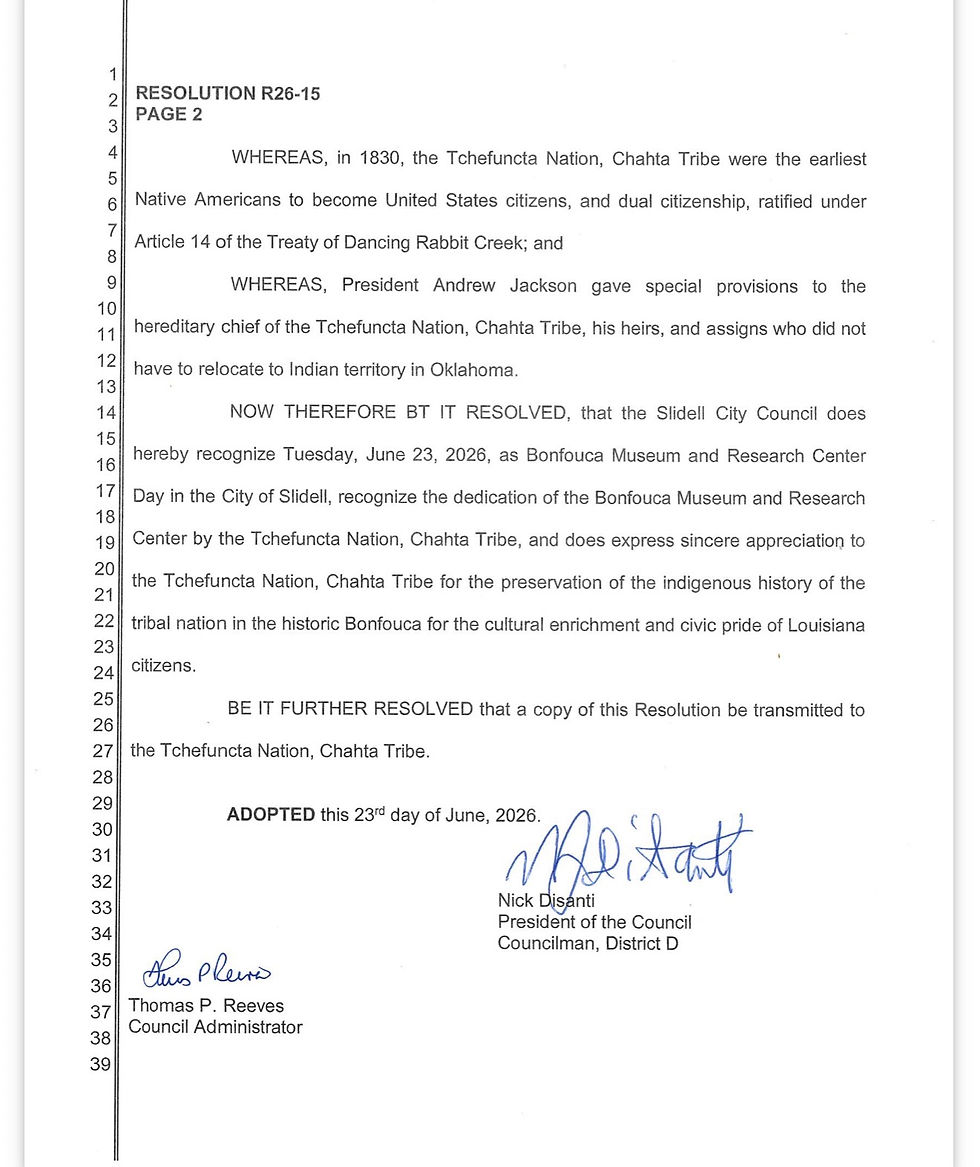
In addition to the state resolution, the City of Slidell adopted its own resolution recognizing June 23, 2026 as Bonfouca Museum and Research Center Day within the city.
The city resolution mirrors many of the Legislature's findings and formally expresses appreciation for:
preserving Indigenous history
promoting education
preserving American Indian artifacts
increasing tourism
strengthening community pride
supporting the Bonfouca Museum and Research Center
The resolution was adopted unanimously by the Slidell City Council and transmitted to the Tchefuncta Nation, Chahta Tribe.
Why this matters historically
Viewed together, these actions represent several important milestones:
Louisiana officially recognized the Bonfouca Museum and Research Center at the state level.
The City of Slidell issued its own formal recognition and appreciation.
Indigenous history was publicly acknowledged as part of Louisiana's cultural heritage.
The museum was recognized as an educational and cultural resource for residents, students, researchers, and visitors.
The Tchefuncta Nation, Chahta Tribe received formal governmental recognition for its role in preserving Indigenous history and culture.
For anyone interested in Louisiana history, American Indian history, or cultural preservation, these resolutions represent a noteworthy example of state and local governments formally supporting Indigenous historical preservation efforts.
More Than a Museum
Museums preserve objects.
Great museums preserve civilizations.
The Bonfouca Museum and Research Center was established with a vision far greater than displaying artifacts. It exists to preserve the history, traditions, oral knowledge, and enduring legacy of the Tchefuncta Nation, Chahta Tribe while creating an educational resource for future generations.
Through SCR 78, the Louisiana Legislature acknowledged the museum's role in promoting:
• Indigenous history
• American Indian artifacts
• Education
• Cultural enrichment
• Tourism
• Economic development
• Community pride
These are not simply ceremonial words.
They are an official recognition by the State of Louisiana that Indigenous history belongs at the center of Louisiana's story.


A Historic Recognition of Indigenous Leadership
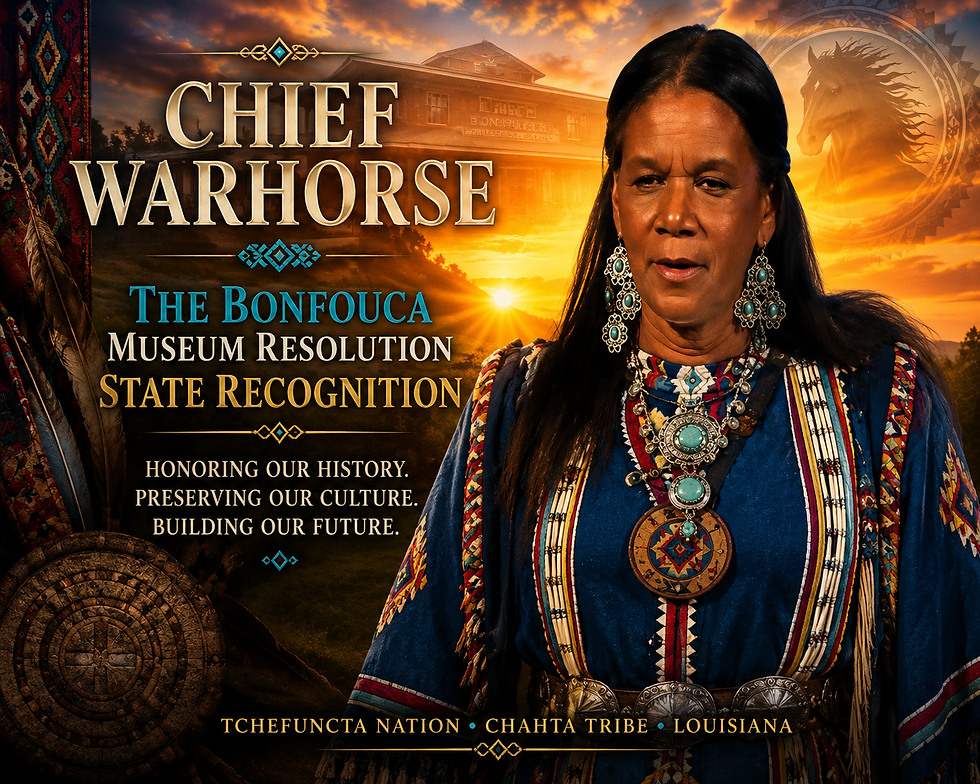
Perhaps even more meaningful than the museum itself is what these resolutions recognize through the leadership of Queen Chief Elwin Warhorse Gillum, Chief of the Chahta Tribe and Queen of the Tchefuncta Nation.
Throughout history, Indigenous leaders have often carried enormous responsibilities while receiving little public recognition.
Chief Warhorse represents a different chapter.
Her leadership has become a bridge between tribal tradition and modern government.
She has demonstrated that Indigenous diplomacy is not simply about preserving the past.
It is about helping shape the future.
Through years of relationship building, cultural education, and community service, she has earned the respect of elected officials, historians, educators, and citizens alike.
Watching her interact with civic leaders reveals something remarkable.
Respect cannot be legislated.
It must be earned.
Chief Warhorse has earned it.
The resolutions adopted by both the Louisiana Legislature and the City of Slidell stand as public acknowledgments of the value of her leadership and the work of the Chahta Tribe in preserving Indigenous heritage.
A Blueprint for Other Communities
The Bonfouca Museum should not simply be viewed as a local achievement.
It should be studied as a model.
Across America, cities are searching for ways to preserve local history while strengthening relationships with Indigenous communities.
Bonfouca demonstrates that this can be accomplished through partnership rather than division.
Government.
Tribal leadership.
Researchers.
Educators.
Community members.
Each has a seat at the table.
When these groups work together, everyone benefits.
The result is more than a museum.
It becomes a living classroom.
Historical Misclassification and the Indigenous Vision for the Future. COMING SOON! THE BIG MEETING

The Next Chapter Begins
History never stands still.
While Louisiana celebrates the opening of the Bonfouca Museum and Research Center, another historic conversation is preparing to begin.
An extraordinary panel is coming together to discuss one of the most important issues facing Indigenous communities today:
Historical Misclassification and the Indigenous Vision for the Future.
Bringing together voices from tribal leadership, scholarship, community organizing, and popular culture, this upcoming session represents an opportunity to inspire a new generation of Indigenous thinkers and leaders.
The Voices of Tomorrow
Queen Chief Elwin Warhorse Gillum
As Chief of the Chahta Tribe and Queen of the Tchefuncta Nation, Chief Warhorse has become known for her philosophy known as the Trail of Healing.
Her leadership emphasizes diplomacy, education, cultural preservation, and building meaningful relationships between tribal governments and surrounding communities.
She demonstrates that strength and compassion are not opposing qualities.
Together, they define enduring leadership.
Waka Flocka: "I'm Not African, I Am A Black Indian Of America"
Waka Flocka Flame
Known around the world as one of hip hop's most recognizable artists, Waka Flocka Flame has also spoken publicly about his Indigenous ancestry and his pride in that heritage.
His willingness to acknowledge that identity on a global platform gives visibility to conversations that many families have carried privately for generations.
As an artist whose influence reaches millions, his participation creates an opportunity to encourage younger audiences to explore their own family histories and cultural roots.
His presence reminds us that success and cultural identity can stand together.
Raspy Rawls
Raspy Rawls has become a respected voice advocating for Indigenous identity, cultural awareness, and historical truth.
His work reflects a commitment to community education and preserving stories that have too often remained overlooked.
He represents the importance of grassroots leadership—where change begins through conversation, research, and service to the people.
Phoenix Moon
As Founder of the Urban Indian Heritage Society, Phoenix Moon has dedicated herself to creating opportunities for Urban Indians whose histories and identities have often been misunderstood or overlooked.
Her work has focused on education, advocacy, and building spaces where Indigenous voices can be heard with dignity and respect.
She represents a new generation of Indigenous women leaders who are helping shape the future while honoring the wisdom of those who came before them.

Historical Misclassification and the Indigenous Vision for the Future.
A New Generation Is Watching
Young people today are searching for examples.
They want leaders who live their values.
They want authenticity.
They want hope.
Seeing an internationally recognized musician sit beside an Indigenous Chief.
Watching respected community advocates engage in meaningful dialogue.
Witnessing women leading at the highest levels of Indigenous organizations.
These images matter.
Representation matters.
History matters.
The conversations that begin today will influence the decisions made tomorrow.
Beyond Misclassification
The upcoming discussion is about more than correcting historical records.
It is about restoring stories.
Recovering family histories.
Preserving culture.
Creating educational opportunities.
Strengthening communities.
And ensuring that future generations inherit truth rather than confusion.
For many Urban Indians and Indigenous families, these conversations represent not only history but identity.
The goal is not simply to look backward.
It is to move forward together with greater understanding, respect, and opportunity.

Looking Toward the Future
The opening of the Bonfouca Museum and Research Center is not the end of a journey.
It is the beginning of one.
Louisiana has recognized an Indigenous institution.
A city has honored Indigenous leadership.
A museum now stands to educate generations yet unborn.
And a new conversation is preparing to unite artists, tribal leaders, advocates, and educators around a shared vision for the future.
That is how lasting change begins.
Not through a single resolution.
Not through one ceremony.
But through people who choose to preserve history, build relationships, and inspire others to continue the work.
As the doors of the Bonfouca Museum open, they invite every visitor to look beyond the exhibits and see something even more enduring: a living culture that continues to shape Louisiana, strengthen communities, and inspire future generations.
The next chapter of Indigenous history is not simply being remembered.
It is being written.


Comments