

Indian Blood Beneath the Word “Negro”

They Remembered What the Records Erased: Indigenous Lineage, Federal Slave Narratives, and Ethnonullification
There are moments when an archive stops feeling like a collection of aging paper.
A name appears.
A family relationship is spoken.
A mother, grandmother, or great grandmother is remembered as Indian.
A language once spoken inside a family rises again from a typewritten page.
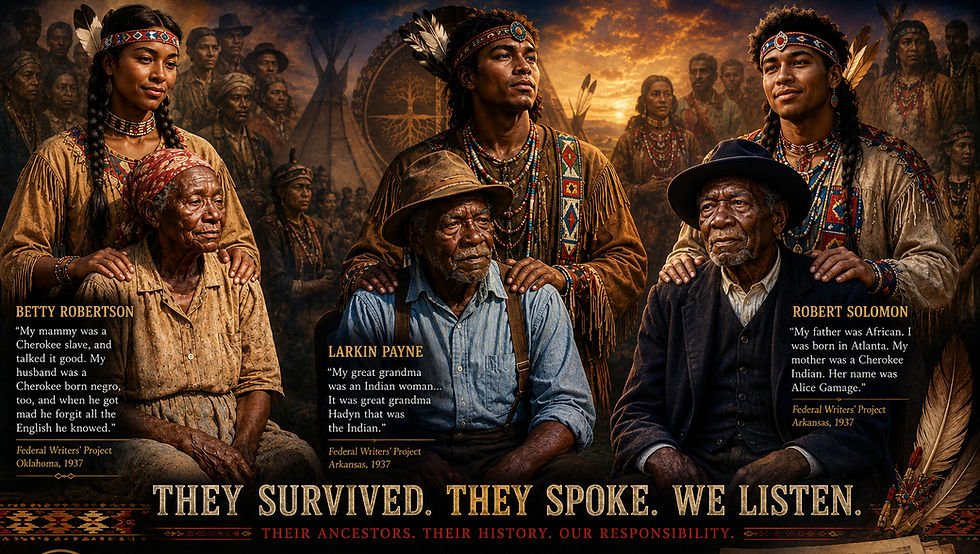
That is what happens when we read the testimonies of Betty Robertson, Larkin Payne, and Robert Solomon. These individuals were interviewed during the 1930s as part of the Federal Writers’ Project collection commonly known as the Federal Slave Narratives. Their statements survived in records now preserved by the Library of Congress.
They were not speaking as modern historians looking backward from a safe distance. They were speaking from family memory, personal experience, inherited knowledge, and lives shaped by slavery, war, emancipation, migration, violence, and survival.
They also spoke within records that identified them primarily through the racial world of slavery.
Yet inside those records, they named their Indigenous ancestry.
That distinction matters.

“My mammy was a Cherokee slave, and talked it good. My husband was a Cherokee born negro, too, and when he got mad he forgit all the English he knowed.”
Betty Robertson: A Cherokee Mother, a Cherokee Husband, and a Language That Survived
Betty Robertson was interviewed at Fort Gibson, Oklahoma, at the reported age of ninety three. She said that she had been born near Webbers Falls in the Canadian District of the Cherokee Nation.
Her testimony places her life within a clearly identified Cherokee geographical and community setting.
Betty stated:
“My mammy was a Cherokee slave, and talked it good. My husband was a Cherokee born negro, too, and when he got mad he forgit all the English he knowed.”
This is not a vague family legend recorded generations later.
Betty named her mother as a Cherokee enslaved woman. She described her mother as speaking Cherokee. She identified her husband as a “Cherokee born negro,” and she remembered that Cherokee became his language when anger caused his English to fall away.
Language is especially important here.
Cherokee identity was not presented merely as a distant blood claim. It existed in speech, marriage, location, family relationships, and everyday life.
The words “Cherokee born negro” also expose the danger of reading racial labels as complete ethnic identities. The word “negro” was imposed or used within the racial structure of the period, yet Betty placed Cherokee identity beside it without contradiction.
The racial label did not erase the Cherokee relationship in her memory.
It may, however, have hidden that relationship from later researchers who searched only records marked Negro, Black, Colored, or slave.
Betty Robertson’s testimony appears in the Federal Writers’ Project, Slave Narrative Project, Volume 13, Oklahoma, Adams through Young, page 266.

“My great grandma was an Indian woman... It was great grandma Hadyn that was the Indian.”
Larkin Payne: “It Was Great Grandma Hadyn”
Larkin Payne was interviewed by Irene Robertson in Brinkley, Arkansas. He was recorded as eighty five years old and said he had been born in North Carolina.
His testimony carries the sound of a man organizing the family history still available in his memory. He named his parents as Sarah Hadyn and John Payne. He remembered family members being sold. He remembered stories of the Civil War, freedom, migration, and the violence of the Ku Klux Klan.
Then he made a direct ancestral identification:
“My great grandma was an Indian woman... It was great grandma Hadyn that was the Indian.”
Larkin did something genealogically significant.
He did not merely say that there was “Indian blood” somewhere in the family.
He identified the generation.
He identified the maternal family name.
He identified great grandma Hadyn as the Indian ancestor.
This is the kind of testimony that can open an entire field of research. The statement invites a search through North Carolina records, family migrations, freedom documents, census schedules, court records, marriages, land transactions, and the Hadyn family line.
It also reveals how Indigenous ancestry traveled through oral history when official documents failed to preserve it.
Larkin Payne’s recollection survived because someone asked him about his life and because he answered with the names of his people.
His answer now gives descendants and researchers a place to begin.
His testimony appears in the Federal Writers’ Project, Slave Narrative Project, Volume 2, Arkansas Narratives, Part 5, McClendon through Prayer, page 306.

“My father was African. He was born in Atlanta. My mother was a Cherokee Indian. Her name was Alice Gamage.”
Robert Solomon: Alice Gamage, a Cherokee Mother Remembered by Name
Robert Solomon was interviewed in Des Arc, Arkansas, at the reported age of seventy three.
His testimony begins with a remarkable declaration:
“My father was African. I was born in Atlanta. My mother was a Cherokee Indian. Her name was Alice Gamage.”
Within four short sentences, Robert preserved two ancestral worlds.
He identified his father as African.
He identified his mother as Cherokee.
Most importantly, he gave his mother her name: Alice Gamage.
Robert continued by describing communication between his parents, his mother’s language, his grandmother Gamage, and family movement involving Florida, Georgia, and Indian Territory. He said that his mother taught him her language and that he spoke for his parents.
This is more than a statement about biological ancestry.
It is a memory of an Indigenous mother transmitting language to her son.
It is a story of cultural connection surviving inside a family that later records could easily place into a single racial category.
Alice Gamage did not disappear completely.
Her son spoke her name.
The interview preserved it.
The archive now has a duty to carry it forward accurately.
Robert Solomon’s testimony appears in the Federal Writers’ Project, Slave Narrative Project, Volume 2, Arkansas Narratives, Part 6, Quinn through Tuttle, page 208. Interviewer: Miss Irene RobertsonPerson interviewed: Robert Solomon, Des Arc, ArkansasAge: 73
My father was African. He was born in Atlanta. My mother was a Cherokee Indian. Her name was Alice Gamage. I was born in 1864. I don't know where I was born—think it was in the Territory—my father stole my mother one night. He couldn't understand them and he was afraid of her people. He went back to Savannah after so long a time and they was in Florida when I first seen any of her people. When I got up any size I asked my father all about him and my mother marrying. He said he knowed her 'bout two year 'fore they married. They sorter courted by signs—my mother learned me her language and it was natural fur me to speak my father's tongue. I talked for them. She was bout fifteen when she run away. I don't know if a preacher ever did marry em or not. My father said she was just so pretty he couldn't help lovin' her. He kept makin' signs and she made signs. I liked my Gramma Gamage. She couldn't understand much. We all went to the Indian Territory from Florida and Georgia. That's how I come out here.
I don't remember the Ku Klux. I remember hearing ma and gramma talk 'bout the way they tried to get way from 'em. My father was a farmer till freedom. He farmed around here and at Pine Bluff. He died at West Point. My mother and step-mother both died at Pine Bluff. They took my mother to her nation in Oklahoma. She was sick a good while and they took her to wait on her. Then come and took her after she died. There show is a fambly. My father had twenty-two in his fambly. My mother had five boys and three girls and me. My stepmother had fourteen more children. That's some fambly aint it? All my brothers and sisters died when I was little and they was little. My father's other children jess somewhar down round Pine Bluff. I guess I'd know em but I aint seed none of them in I don't know how long.
The first work I ever done was sawmilling at Pine Bluff. Then I went down in Louziana, still sawmilling—I followed dat trade five or six years. Den I got to railroading. I was puttin down cross ties and layin' steel. I got to be straw boss at dat. I worked at dat fifteen years. I worked doing that in six different states. That was show fine livin'—we carried our train right along to live in. I married and went to farming. Then I come to work at this oil mill here (in Des Arc). The reason I quit. I didn't quit till it went down and moved off. I aint had nothin' much to do since. I been carryin' water and wood fur Mrs. Norfleet twenty years and they cooks fur me now. My wife died 'bout a year ago. She been dead a year last January. She was sick a long time 'fore she died. Well the relief gives me a little to eat, some clothes and I gets $5.00 a month and I takes it and buys my groceries and I takes it up to Mrs. Norfleet's. They says come there and eat. They show is good to me 'cept I aint able to carry the wood up the steps much no more. It hurt me when I worked at the oil mill. I helped them 'bout the house all the time.
What I do wid my money I made? I educated my girls. Yes maam I show is got children. One my girls teaches school in St. Louis and de other at Hot Springs. They both went to college at Pine Bluff. I sent em. No'm dey don't help me. They is by my second wife and my first wife live with my son, down close to Star City. Dey farm. It's down in Lincoln County. They let me live in this house. It belongs to him. I went to the bank fo' it closed and got my money whut I had left. I been livin' on it but it give out.
The conditions are all right. They kin make a right smart but everything is so high it don't buy much. Some of 'em say they ain't goiner do the hardest work, hot or cold and liftin' for no dollar a day. Don't nobody work hard as I used to. There's goiner be another war and a lot of them killed—'cause people ain't doin right. Some don't treat the others right. No'm they never did. They used to threaten em and take 'em out in cars and beat 'em up, just for disputin' their word or not paying 'em and de lack. The white man has cheated a heap because we was ignorant and black. They gamble on the cotton and take might' near all of it for the cheap grub they let out to make de crop on. Conditions are better but a heap of the young black and white too deblish lazy to work. Some of dem get killed out goin' on at their meanness.
I heard of uprisings since the war but I never was 'bout none of them.
I votes the Republican ticket. The last I voted was for Hoover. Sure they have tried to change my way of voting but I ain't goiner change. I ain't heard nothin' 'bout no restrictions 'bout votin'. If a woman wanter vote it's all right. My girs and my boy votes right along. They are all Republicans.
The most money I ever has at one time was $600.00. I did save it. I spent it on my girls' clothes and education. They did go to college at Pine Bluff but they went to the Catholic High School first down at Pine Bluff. No'm they don't help me. They say it's all dey can do to get along. They never have told me how much they make.
The Child Follows the Condition of the Mother
The testimonies also raise a serious legal question.
In 1662, colonial Virginia enacted the rule later described as partus sequitur ventrem, meaning that a child’s legal status followed the condition of the mother.
The statute declared that children born in the colony would be “bond or free” according to the condition of their mother. This rule helped colonial slavery become hereditary. A child born to an enslaved woman could be treated as enslaved regardless of the identity or legal status of the father.
But the rule also carried an unavoidable opposite meaning.
A child born to a legally free woman was supposed to be free.
Therefore, when a free American Indian woman was unlawfully enslaved, or when her descendants were treated as slaves without lawful proof that she had been enslaved, the bondage imposed upon the maternal line could be challenged.
Virginia freedom cases later relied upon Indian maternity. In Hudgins v. Wright and related litigation, proof of descent through an Indian woman became a basis for freedom. Virginia Humanities summarizes the resulting principle by explaining that Indians came to be treated as a free class and that freedom could be established through proof of Indian maternal ancestry.
This does not mean that every enslavement of an American Indian was illegal under every colonial government.
The law was inconsistent and often deliberately cruel. Virginia sometimes prohibited the enslavement of Indians, sometimes permitted the enslavement of war captives, and sometimes ignored its own restrictions. Its 1705 slave code also created legal mechanisms under which certain people imported into the colony could be declared enslaved.
The historically defensible conclusion is more precise:
Many American Indians were enslaved unlawfully, and many descendants may have been held through legally defective claims of hereditary slavery, especially where the maternal ancestor was a free Indian woman.
That is the question the archive must investigate family by family.
Collection
Born in Slavery: Slave Narratives from the Federal Writers' Project, 1936 to 1938
Born in Slavery: Slave Narratives from the Federal Writers' Project, 1936-1938 contains more than 2,300 first-person accounts of slavery and 500 black-and-white photographs of former slaves.
The First Tribe Archive Project
The Federal Writers’ Project collected approximately 2,300 interviews with formerly enslaved people during the 1930s. The surviving collection has become one of the largest bodies of first person testimony concerning American slavery. Arkansas alone contributed nearly seven hundred narratives, almost one third of the total collection.
These records are invaluable, but they must be handled responsibly.
Many interviewers were white. The racial customs of the segregated South may have affected what interviewees felt safe enough to say. Dialect was sometimes exaggerated or inconsistently transcribed. Some interviews were shortened, reorganized, or copied from earlier drafts. The Library of Congress itself warns researchers to consider the identity of the interviewer, the circumstances of the interview, and the unequal power present in the room.
The First Tribe Historical Research Institute is therefore not simply collecting interesting quotations.
We are constructing a documented archive of individuals who identified American Indian ancestry within the Federal Slave Narratives. Each entry must preserve the person’s name, location, age when available, exact language, interviewer, volume, page, and archival source.
The purpose is not to make every person in the collection Indigenous.
The purpose is to listen carefully when an individual identifies an Indian mother, father, grandparent, family language, tribal community, or ancestral relationship.
Their words deserve to be recorded accurately.
Their families deserve to know those words exist.
From Indian Ancestry to Negro, Black, and Colored
The racial descriptions found in the slave narratives cannot automatically be treated as complete statements of ancestry.
Federal records repeatedly compressed complicated communities into a small number of racial boxes. The National Archives explains that early census schedules often classified people only as White, Black, Mulatto, enslaved, or free people of color. American Indians living outside recognized Indian Country could disappear inside those categories.
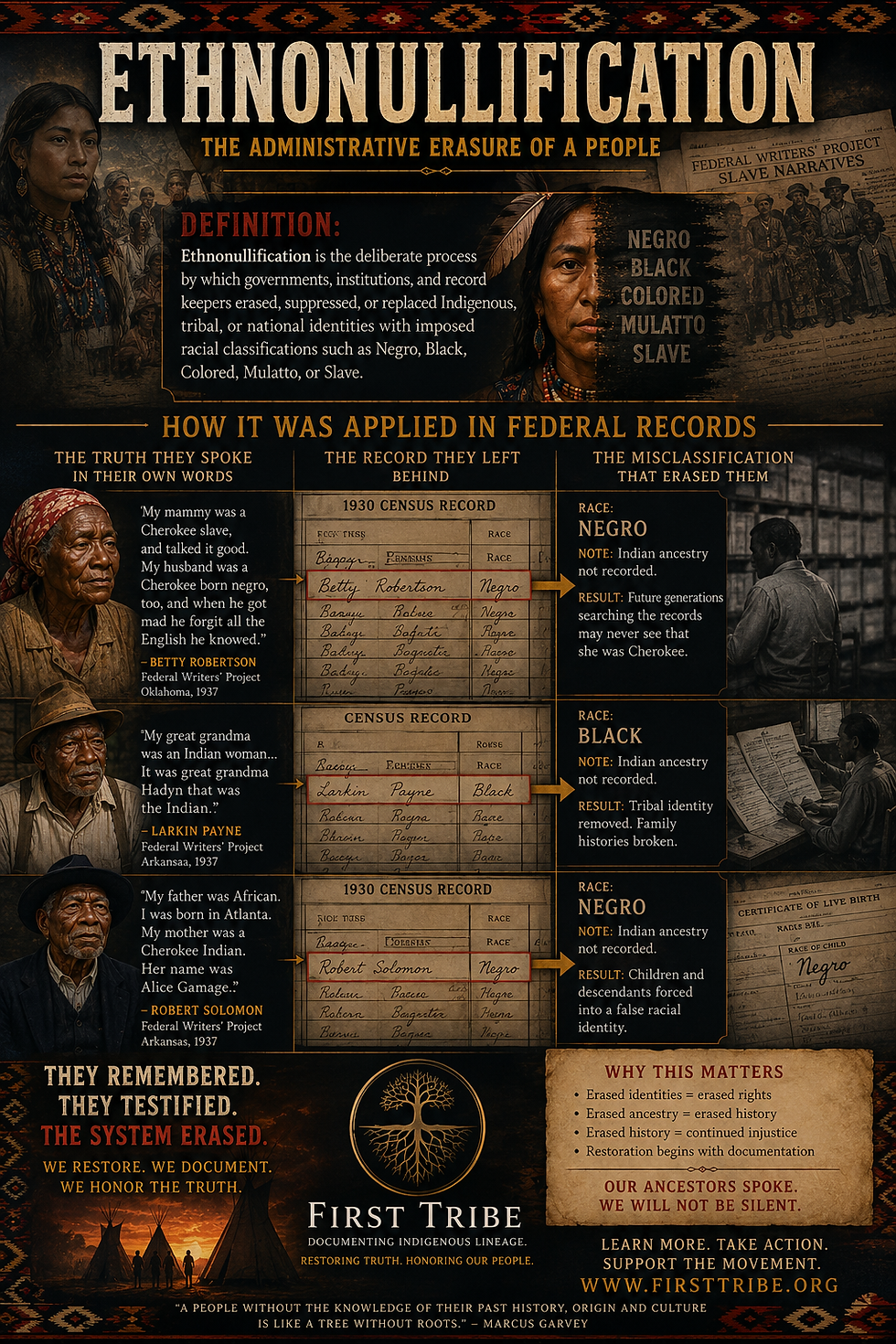
By 1930, federal census instructions explicitly told enumerators that a person of both American Indian and African ancestry should generally be recorded as Negro unless Indian ancestry “predominated” and the person was accepted as Indian within the community.
This was not neutral record keeping.
It created a structure in which African ancestry could override Indian identity on paper.
In Virginia, the consequences became even more direct. State officials pressured agencies to classify many citizens who identified as Indian as Colored. The National Park Service describes this process as a form of “paper genocide” that damaged the ability of tribal families to document their ancestry across generations.
First Tribe describes this process as Ethnonullification.
Ethnonullification occurs when a people’s national, tribal, cultural, or ancestral identity is administratively suppressed beneath an imposed racial category. The person remains alive. The family remains alive. The ancestry remains alive. But the official record increasingly tells another story.
Indian becomes Colored.
Cherokee becomes Negro.
A tribal family becomes a racial statistic.
Eventually, descendants searching the records are told that their ancestors were never Indian because the very documents used as proof were created by systems that refused to record them as Indian.
These Testimonies Are Not the End of the Research
Betty Robertson, Larkin Payne, and Robert Solomon do not, by themselves, prove every broader historical claim concerning American Indian enslavement or racial reclassification.
They do something equally important.
They provide primary source testimony.
Betty named a Cherokee mother and Cherokee husband.
Larkin named great grandma Hadyn as Indian.
Robert named his Cherokee mother, Alice Gamage.
Their words establish research leads that deserve investigation through additional records.
That is why the First Tribe project is building more than a list of quotations. We are building a research path from testimony to family, from family to documents, from documents to historical context, and from historical context to a more truthful account of American identity.
Some lines will be confirmed.
Some will remain probable or possible.
Some may be disproven by later evidence.
Honest research must make those distinctions.
But none of these voices should be dismissed simply because an interviewer, census taker, county clerk, or government agency placed the speaker inside a racial category that failed to preserve the whole person.
Their Words Survived
Slavery attempted to turn human beings into property.
Misclassification attempted to turn nations, tribes, families, and ancestral identities into racial labels.
Yet these individuals spoke.
They named their mothers.
They named their grandmothers.
They remembered languages.
They remembered Indian Territory.
They remembered the people who came before them.
That is courage.
That is survival.
That is ancestral testimony.
The First Tribe Historical Research Institute is committed to finding these voices, verifying their words, documenting their sources, and restoring their testimony to the historical record with dignity.
We do not speak over them.
We allow them to speak again.
Their words survived.
Now we must be worthy enough to listen.


Comments