

Ethnonullification: The Misclassification of Mayan and Indigenous Peoples Into “Negro” Racial Categories in Colonial America and modern records


For generations, the history of slavery in the Americas has largely been presented through a simplified framework: Africans were enslaved, while Indigenous peoples were merely displaced westward. Yet mounting historical evidence reveals a far more complex and disturbing reality. Across the Americas from Belize and Jamaica to Virginia and the Carolinas Indigenous peoples were enslaved in massive numbers, trafficked through colonial markets, and frequently reclassified into racial categories such as “Negro,” “mulatto,” and “Black.” This history is not all Black people but it is relevant to many Black lineages in the United States in both Southern and Northern Indigenous origins.
This process did not merely obscure ancestry. It contributed to what many researchers today described as Ethnonullification: the administrative and documentary erasure of Indigenous identity through colonial law, racial classification systems, plantation records, and census practices.
Modern scholarship is now openly acknowledging what many descendants, oral traditions, and independent researchers have argued for years: significant Indigenous populations disappeared into colonial racial categories through slavery and bureaucratic reclassification.

600,000 Indigenous Peoples enslaved in North America VS. 388,000 Africans to America
Indigenous Slavery Was Massive Not Marginal
Historian Linford D. Fisher, in Stealing America, estimates that nearly 600,000 Indigenous people were enslaved in North America alone.
This figure is historically significant because historians estimate that approximately 388,000 enslaved Africans were directly imported into British North America during the transatlantic slave trade.
This comparison does not diminish African slavery. Rather, it reveals a historical reality long minimized in public education:
Indigenous slavery was not a minor side story of colonial America it was one of its foundational labor systems.
Fisher explains that colonizers:
captured Native populations,
sold Indigenous captives across colonies,
trafficked Native peoples into Caribbean plantation systems,
and often deliberately mislabeled Indigenous captives as “Black” or “Negro” to conceal their origins.
“Documentary Genocide” and the Erasure of Indigenous Identity
One of the most important concepts emerging from modern scholarship is what Indigenous scholars have called:
“Documentary genocide”
Fisher describes this as the erasure of Native identity through:
census records,
plantation ledgers,
church registries,
racial slave codes,
and legal classification systems.
Colonial governments frequently recorded enslaved Indigenous people simply as:
“Negro”
“mulatto”
“colored”
or “Black”
even when Native ancestry was known.
According to Fisher:
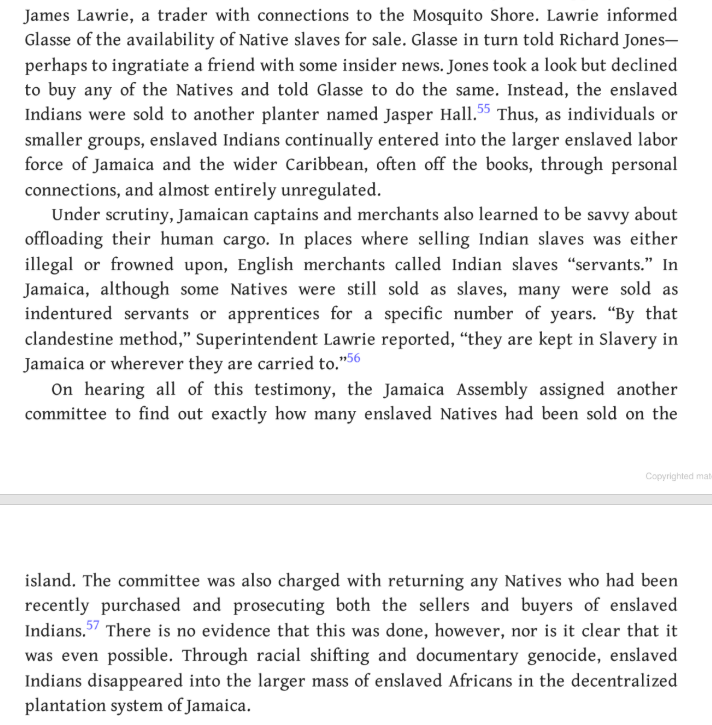
“Through racial shifting and documentary genocide, enslaved Indians disappeared into the larger mass of enslaved Africans in the decentralized plantation system of Jamaica.”
This statement is extraordinarily important because it openly acknowledges:
racial reclassification,
identity suppression,
and statistical disappearance of Indigenous peoples within colonial slave systems.
This process forms a major component of what researchers today identify as Ethnonullification the bureaucratic nullification of Indigenous identity.
Author Talk: Linford D. Fisher — Stealing America - with Mishy Jacobson
Colonial Laws Merged Indigenous and African Peoples Into Shared Slave Categories
Colonial statutes reveal that racial categories were not fixed biological realities, but political and economic tools used to construct a permanent enslaved class.
In Virginia during the seventeenth century, laws grouped together:
“Negroes”
“Moors”
“Mulattoes”
and “Indians”
as populations that:
“would be taken to be slaves.”
Barbados slave laws similarly collapsed Indigenous and African peoples into the category of “Negroes,” helping establish racialized slave systems later exported into the American South.
Fisher notes that:
“This law collapsed Native Americans and Africans into the category of ‘Negroes.’”
That statement is historically profound.
It demonstrates that “Negro” increasingly functioned not merely as an ethnic label, but as a colonial legal caste tied to enslavement.
As Indigenous peoples intermarried, were displaced, or entered plantation systems alongside Africans, colonial authorities frequently stopped identifying them tribally and instead absorbed them into generalized racial categories.
The Hidden Mayan Slave Trade
One of the least discussed aspects of colonial slavery involves the trafficking of Mayan peoples from Central America into the Caribbean and Southern colonies.
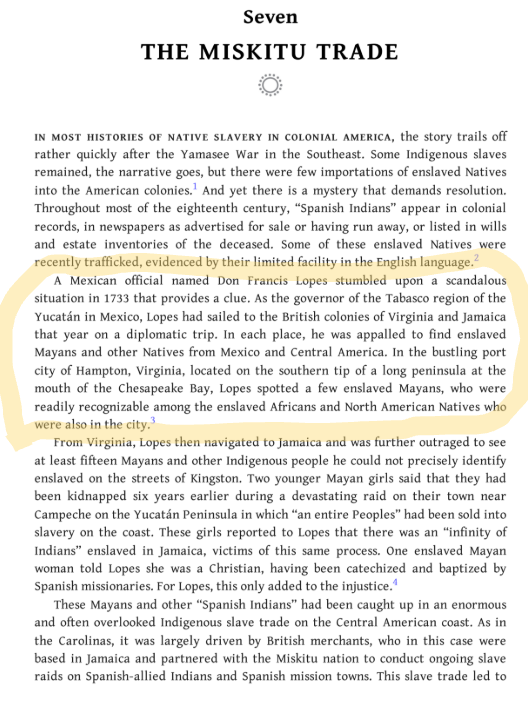
In Chapter Seven of Stealing America, titled “The Miskitu Trade,” Fisher documents eyewitness testimony from Mexican official Don Francis Lopes, who encountered enslaved Mayans in both Virginia and Jamaica during the eighteenth century.
Lopes reported seeing:
enslaved Mayans in Hampton, Virginia,
Indigenous captives from Central America,
and “an infinity of Indians” enslaved in Jamaica.
According to the account, Mayan girls explained they had been kidnapped during devastating raids on towns near Campeche in the Yucatán Peninsula, where:
“an entire Peoples” had been sold into slavery.
These are not modern speculations. They are documented historical testimonies.
Belize, Jamaica, and the Southern Colonies
Additional historical sources independently confirm these trafficking routes.
In British Honduras to Belize: Transformation of a Nation, author Godfrey Mwakikagile writes:
“The British buccaneers and pirates also attacked the Maya… They also stole food, enslaved the Maya, and kidnapped Mayan women and children.”
The source further explains:
“Some Mayans were even sold as slaves to British plantation owners and settlers in Jamaica. Some were also sold to slave masters in the southern states of the United States, especially North Carolina, South Carolina, and Virginia.”
This evidence aligns with:
colonial records,
Caribbean trafficking networks,
plantation economies,
and modern scholarship documenting Indigenous enslavement throughout the Atlantic world.

The Carolinas and the Machinery of Ethnonullification
The Carolinas became one of the largest centers of Indigenous slave trading in English North America.
Historians have documented:
Indigenous slave raids,
intertribal warfare encouraged by colonists,
Native trafficking routes,
and the export of Indigenous captives into Caribbean plantations.
Women and children were especially vulnerable because their descendants could rapidly disappear into colonial racial systems over generations.
Once tribal identities disappeared from records, descendants were increasingly labeled only as:
“Black”
“Negro”
“mulatto”
or “colored.”
This was not always accidental confusion.
In many cases, the suppression of Indigenous identity became legally and economically useful to colonial authorities and slaveholders.


First Tribe Nation and the Reexamination of Hidden Indigenous Histories
Earlier investigations published by First Tribe Nation explored records involving Mayan captives trafficked into Virginia and the Carolinas.
One article in particular, Mayan Slaves Kidnapped and Brought to the Carolinas and Virginia, highlighted historical evidence now increasingly reinforced by mainstream scholarship.
What was once dismissed by critics is now being openly discussed by historians:
Indigenous slavery was widespread,
Native peoples were trafficked into plantation systems,
and many Indigenous identities disappeared administratively into colonial racial classifications.
The implications are enormous for:
genealogy,
census interpretation,
tribal continuity,
and modern identity discussions.
Ethnonullification: The Administrative Erasure of a People
The historical evidence increasingly suggests that many Indigenous populations were not merely physically displaced they were administratively erased.
Through:
racial recoding,
plantation bookkeeping,
census manipulation,
slave laws,
and documentary suppression,
Indigenous peoples could vanish from official records while their descendants remained physically present within broader populations classified as “Black” or “Negro.”
This process of Ethnonullification represents one of the least discussed dimensions of colonialism in the Americas.


A Hidden Population Inside the Records
The emerging scholarship surrounding Indigenous slavery is reshaping our understanding of American history.
The evidence now demonstrates:
Indigenous slavery existed on a massive scale,
Mayan and other Native populations were trafficked into the Caribbean and Southern colonies,
colonial governments merged Native and African peoples into shared slave categories,
and many Indigenous identities disappeared through documentary erasure.
This history does not erase African suffering, nor does it reduce all racial identities into a single narrative.
Instead, it reveals something far more historically complex:
Colonial racial systems often absorbed Indigenous peoples into categories designed to conceal ancestry, expand labor systems, and erase Native identity from the historical record.
As more archival evidence emerges, America may be forced to confront a reality long hidden inside plantation ledgers, census books, and forgotten slave routes:
A significant Indigenous population did not simply disappear.
Many were renamed.
FIRST TRIBE


Comments