

🔥 Before the Ivy: The American Indian Origins of Harvard University

The First Tribe Legacy Behind America's Oldest University

Long before Harvard became synonymous with the Ivy League, it maintained a mission that many Americans have forgotten. The Charter of 1650 declared that Harvard existed for the education of both "English and Indian youth." In pursuit of that mission, the university established the Indian College in the 1650s, welcomed Native students into its halls, printed the first Bible produced in British North America in an Indigenous language, and graduated Caleb Cheeshahteaumuck the first known American Indian graduate of Harvard University. Yet despite this remarkable history, the Indigenous roots of Harvard have largely disappeared from public memory. This article examines the documented American Indian origins of Harvard University and the enduring legacy of its forgotten First Tribe scholars.
When most people hear the history of Harvard, they learn that it was founded in 1636 and became America's oldest institution of higher learning. What is often overlooked is that Harvard's governing charter explicitly included the education of Indigenous youth, and that the university established a dedicated "Indian College" in the 1650s for Native students. This institution produced the first known American Indian graduate of Harvard, Caleb Cheeshahteaumuck of the Wampanoag Nation, in 1665

Harvard's Original Charter Included Indigenous Education
One of the most important primary documents in Harvard's history is the Charter of 1650.
The charter states that Harvard existed for:
"the education of English and Indian youth."
This language remains part of Harvard's governing charter today. The commitment was not merely symbolic. Colonial leaders actively sought funds to educate Indigenous students and train Native leaders who could serve as intermediaries between Indigenous communities and colonial society.
Why Was the Indian College Created?
The Indian College was established largely through funding from the London-based Society for the Propagation of the Gospel in New England.
Colonial religious leaders believed Indigenous peoples should be educated in Christianity and European academic traditions. While modern scholars often view these efforts as part of broader colonial assimilation projects, Indigenous students and communities frequently used these educational opportunities in their own ways, acquiring literacy, political knowledge, and diplomatic skills.
The Indian College building was completed around 1655–1656.
According to Harvard's Peabody Museum, it was:
Harvard's first brick building.
Harvard's second educational building.
A residence and instructional space for Indigenous students.
The home of one of the most important printing presses in colonial America.
How Many Native Students Attended?
One of the common misconceptions is that large numbers of Indigenous students attended the college.
In reality, only a handful are known to have studied there.
Harvard's Peabody Museum states that only five Native students attended the Indian College. Harvard historians similarly note that very few Indigenous students ultimately enrolled despite the substantial investment in the institution.
Known Indigenous students include:
Name | Nation |
Caleb Cheeshahteaumuck | Wampanoag |
Joel Hiacoomes (Iacoomes) | Wampanoag |
John Wompas | Nipmuc |
Eleazar | Wampanoag |
John Sassamon (associated with Harvard studies before the building's completion) | Massachusett/Nipmuc connections |

Caleb Cheeshahteaumuck: Harvard's First Native Graduate
The most successful student of the Indian College was:
Caleb Cheeshahteaumuck
Caleb was a member of the Wampanoag people from Martha's Vineyard (Noepe).
After receiving preparatory education, he entered Harvard and completed the same rigorous classical curriculum required of English students. He studied:
Latin
Greek
Hebrew
Logic
Theology
Classical philosophy
Harvard recognizes Caleb as the first Native American graduate in its history. He received his degree in 1665
Joel Hiacoomes: The Forgotten Valedictorian
Another remarkable student was:
Joel Hiacoomes
Historical accounts indicate that Hiacoomes was expected to graduate alongside Caleb and may even have been the leading scholar of the class.
Tragically, he disappeared in a shipwreck while returning to Harvard shortly before commencement. Because of his death, Caleb became the only Indigenous student to complete the degree during that period. Harvard later recognized Hiacoomes' achievement and commemorated his role in the institution's history.
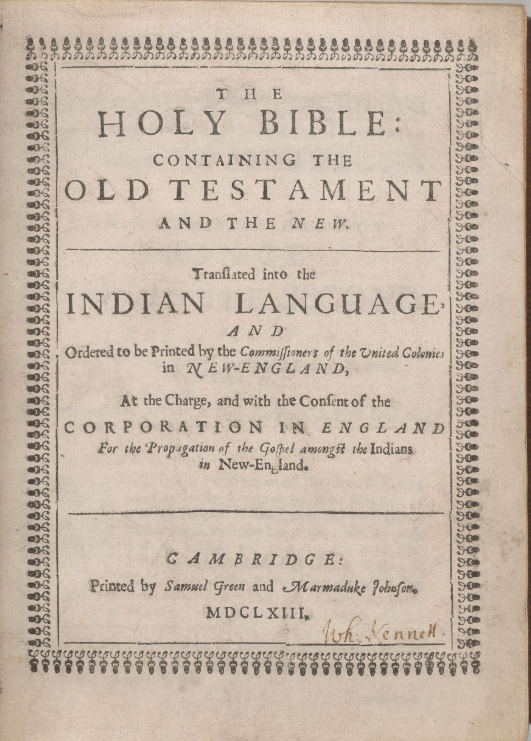
The Indian Bible and Indigenous Printing
One of the most important achievements connected to the Indian College was the publication of the:
Mamusse Wunneetupanatamwe Up-Biblum God
Commonly called the "Eliot Indian Bible."
This was:
The first Bible printed in British North America.
The first complete Bible translated into an Indigenous language in North America.
Printed largely in the Massachusett language.
Indigenous translators and printers played critical roles in this project.
Among them was:
James Printer
a Nipmuc scholar who helped translate and typeset portions of the work. Modern scholarship increasingly recognizes that Native contributors were essential to producing the Bible, not merely passive recipients of missionary instruction.

Archaeological Rediscovery
For centuries the Indian College was largely forgotten.
In 2009, Harvard archaeologists uncovered evidence believed to be connected to the original structure beneath Harvard Yard.
These discoveries helped confirm the building's location and renewed scholarly interest in the Indigenous history of Harvard. Today the Peabody Museum features exhibits discussing the archaeology and history of the Indian College.
Primary and Academic Sources :
Harvard University Native American Program
Harvard Peabody Museum
Harvard Gazette
Harvard Gazette (Archaeology)
Harvard Magazine
Academic Journal
Wolfgang Hochbruck and Beatrix Dudensing-Reichel, "Honoratissimi Benefactores": Native American Students and Two Seventeenth-Century Texts in the University Tradition (1992)
Drew Lopenzina
Red Ink: Native Americans Picking Up the Pen in the Colonial Period (State University of New York Press, 2012). Discusses Indigenous literacy, authorship, and Harvard's Indian College
Margaret Ellen Newell
Brethren by Nature: New England Indians, Colonists, and the Origins of American Slavery (Cornell University Press, 2015). Includes discussion of missionary education and Indigenous-colonial relations.

What the Documentation Shows
Harvard's collections, primarily through the Peabody Museum of Archaeology and Ethnology at Harvard University, have long contained one of the largest collections of Native American ancestral remains in the United States. According to federal NAGPRA reporting data analyzed by ProPublica, Harvard reported more than 10,600 Native American ancestors in its collections and still retained at least 5,400 ancestors that had not yet been made available for return at the time of the analysis. Harvard was listed as having the third-largest collection of unrepatriated Native American remains in the nation.
Harvard's own Peabody Museum acknowledges that it has been engaged in large-scale repatriation efforts under the Native American Graves Protection and Repatriation Act (NAGPRA). As of June 30, 2024, the museum reported returning 4,589 Native American ancestors and more than 11,000 funerary belongings to over 250 Tribal Nations.
Bonus Source Article :
Harvard Holds Human Remains of 19 Likely Enslaved Individuals, Thousands of Native Americans, Draft Report Says
Why Does Harvard Have So Many Native Ancestors?
The collection largely originated during the late nineteenth and early twentieth centuries.
During that era:
Archaeologists excavated Indigenous burial sites.
Museums competed to acquire skeletal collections.
Human remains were often collected without tribal consent.
Academic institutions used ancestral remains for physical anthropology and racial classification studies.
Harvard's Peabody Museum became one of the major repositories of these collections because it was one of the leading anthropology museums in North America.
Many of the ancestors entered Harvard's collections before modern ethical standards existed and before federal law recognized tribal rights to ancestral remains.

Harvard's Own Acknowledgment
Harvard officials have publicly acknowledged the problematic history of these collecting practices.
In recent years Harvard leadership and Peabody Museum officials have issued statements recognizing that many collection practices placed scientific research above respect for Indigenous peoples and their ancestors. Harvard also created a university-wide committee to address human remains across its collections.
The Peabody Museum now describes repatriation as both a legal obligation and an ethical responsibility.

The history of Harvard University cannot be fully told without acknowledging the American Indian men and women who helped shape its earliest years. From the establishment of the Indian College to the graduation of Caleb Cheeshahteaumuck in 1665, Indigenous peoples were present at the very beginning of America's oldest institution of higher learning. Their contributions stand as a testament to resilience, intellect, and perseverance in the face of immense colonial pressures. Today, as descendants and communities seek greater recognition of Indigenous history, the story of Harvard's First Tribe serves as both a reminder and a challenge: a reminder that Indigenous people have always been part of the American story, and a challenge to ensure that their legacy is remembered, honored, and accurately preserved for future generations.
🔥🪶📚
FIRST TRIBE


Comments