
Kwanzaa Is Bigger Than One Man: Co-Creator Makinya Sibeko-Kouaté, Collective Memory, and the Cultural Reminder We Keep Misnaming
- Ishmael Bey

- Dec 28, 2025
- 4 min read

Every December, Kwanzaa returns to Black households across America and with it, a familiar argument. Not about the candles. Not about the principles. But about one man’s name.
That debate misses the point.
Kwanzaa was never meant to stand or fall on a single individual. Insisting that it does is one of the most un-African ways to understand it. To grasp Kwanzaa correctly, we must restore Makinya Sibeko-Kouaté to her rightful place, confront the limits of personality-centered history, and remember that Kwanzaa is not a holiday at all it is a cultural reminder rooted in ancient principles, Indigenous memory, and the unique Black journey in America.¹
The Problem With Single-Name History
Kwanzaa is commonly attributed to Maulana Karenga, who articulated its name and initial framework in 1966. That fact alone, however, has been allowed to overshadow the reality that Kwanzaa was collectively developed within the cultural environment of the US Organization.²
African cultural systems do not operate on the Western “great man” model. They operate on collective authorship. A tradition exists only when it is practiced in households, taught to children, repeated with consistency, and anchored in shared ethics. That work was collective and women were central to it.

Makinya Sibeko-Kouaté: From Concept to Cultural Practice
While many accounts describe Kwanzaa as an idea articulated in 1966, Sister Makinya was among the key figures who transformed that idea into a repeatable, family-centered cultural structure. Her contribution was not theoretical; it was practical, disciplined, and sustained.³
She helped formulate the internal structure of Kwanzaa observance at a moment when nothing about the tradition was yet fixed. This included:
Establishing ritual flow, shaping the order of libation, reflection, and candle lighting so participation not performance was central
Grounding Kwanzaa in the household, ensuring it lived in family space rather than remaining confined to public events or political stages
Developing intergenerational teaching methods, especially for children, so the Nguzo Saba functioned as moral instruction rather than abstract slogans
In African epistemology, this labor is foundational. A tradition is not defined by who names it, but by who stabilizes it through repetition and moral clarity.

Living the Nguzo Saba, Not Just Teaching Them
Sister Makinya’s most enduring contribution was her consistency in living the principles of Kwanzaa year-round. Those who encountered her work recall that the Nguzo Saba were not seasonal language, but daily commitments.⁴
Her life reflected:
Umoja (Unity) through collective decision-making and community-centered leadership
Ujima (Collective Work and Responsibility) through sustained cultural labor that rarely sought recognition
Ujamaa (Cooperative Economics) through mutual aid and resistance to individualistic success models
Nia (Purpose) through a lifelong focus on cultural restoration rather than personal elevation
This alignment between principle and practice is precisely why Kwanzaa survived beyond its political moment.
Touching the Necessary Truth Without Losing the Tradition
There is no benefit in pretending that Karenga’s past is uncomplicated. It is not and for some, that history has become a reason to reject Kwanzaa entirely. Yet a deeper truth remains:
A cultural system does not collapse because one contributor is flawed especially when the system itself is older than the contributor.⁵
The Nguzo Saba are not inventions of the 1960s. They are modern expressions of ancient African ethical systems collective responsibility, shared purpose, and faith in the people. To abandon these principles because of one biography is to misunderstand African continuity itself.
Corn, First Fruits, and Indigenous Memory
Kwanzaa’s symbolism reaches deeper than East Africa alone. Corn maize holds a central place in Kwanzaa observance, and that detail matters. Corn is Indigenous to the Americas, not Africa.⁶
Its presence quietly acknowledges that:
The Black journey did not end with Africa
Black communities were reshaped on Indigenous land
Survival required the adoption of Indigenous crops, knowledge, and lifeways
Kwanzaa reflects this blended inheritance African values carried through Indigenous soil and American unique struggle.
Language Is Not Origin: Clearing the Tanzania Confusion
Because Kwanzaa uses Swahili (Kiswahili) a language widely spoken in Tanzania some have claimed the holiday itself originated there. That is historically inaccurate.
What is accurate:
Swahili provided terminology, not a pre-existing holiday
Concepts like Ujamaa (cooperative economics) influenced philosophical framing
East African language was chosen intentionally as Pan-African, not tribal
Sister Makinya and other contributors helped translate African values into diasporic practice not import a Tanzanian festival wholesale.
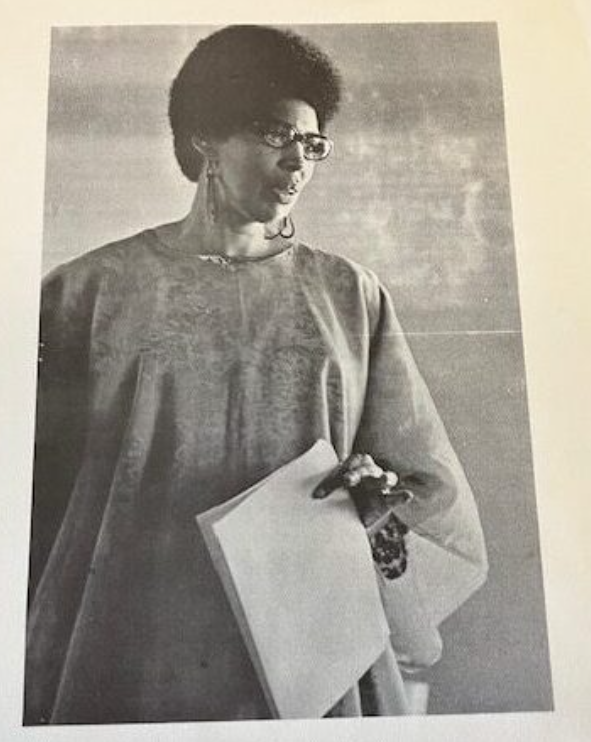
Mother Of Kwanzaa Makinya Sibeko-Kouate
Kwanzaa Is Not a Holiday
Holidays commemorate events. Kwanzaa re-centers a people.
It does not ask what happened it asks who are we now. Each principle functions as a mirror, demanding accountability in unity, economics, purpose, and responsibility. That is why Kwanzaa does not end on December 26th. It is meant to echo through the year.
Why the Collective Frame Matters
Reducing Kwanzaa to a single figure:
Makes it vulnerable to personal scandal
Distorts African epistemology
Erases women’s leadership
Weakens its cultural foundation
Restoring the collective especially figures like Sister Makinya returns Kwanzaa to its proper frame: a people-centered cultural reminder, not a personality-centered invention.

Closing: Cultural Integrity in Human Form
Sister Makinya Sibeko-Kouaté stands as a model of what Kwanzaa actually teaches. She did not argue the principles she lived them. She did not seek ownership she ensured continuity. She reminds us that culture is not validated by its loudest voice, but by its most consistent hands.
Kwanzaa endures not because one man named it, but because people like Sister Makinya carried it with integrity from year to year, from household to household, from principle to practice.
And that is the reminder Kwanzaa was always meant to be.
Footnotes
Karenga, M. Kwanzaa: A Celebration of Family, Community and Culture (early editions).
Umoja wa Wanawake and US Organization internal newsletters, late 1960s–1970s.
Oral histories and community accounts referencing early Kwanzaa structuring roles.
Community recollections cited in Pan-African cultural studies and interviews.
Comparative African cultural theory on collective authorship (Forbes; Asante).
Ethnobotanical consensus on maize origins in the Americas (Smithsonian; FAO).
“Power to the Students and Black Power to Black Students” – The Life and Legacy of Sister Makinya Sibeko-Kouate
Kwanzaa's HIDDEN HISTORY | honoring the Mother Of Kwanzaa Makinya Sibeko-Kouate
FIRST TRIBE


Comments