
Blood, Fire, and Fraud Jim Crow’s War: How Black and Indigenous Land Was Systematically Stolen
- Ishmael Bey

- May 3, 2025
- 6 min read
Black and Indigenous families didn’t “lose” their land — it was stolen. Through violence, crooked laws, and rigged courts, white supremacist systems ripped millions of acres out of their hands.
Land theft wasn’t a tragedy. It was a strategy. And it demands justice.

Stolen Roots: How Jim Crow and White Terrorism Systematically Stripped Black and Indigenous Families of Their Lands
For Black and Indigenous families in the American South, land was more than property. It was survival. It was self-determination. It was freedom wrestled from the hands of an empire built on stolen bodies and stolen soil.
But freedom, as always, was met with a backlash.
From the ashes of Reconstruction rose a system designed to finish what slavery started: stripping Black and Indigenous communities of every inch of power they had carved out for themselves. Jim Crow wasn’t just about water fountains and bus seats — it was about land, wealth, and roots.
The Weaponization of Law and Lynch Mobs
After the Civil War, newly freed Black families and Indigenous survivors, often "heirs" to land either bought, awarded, or reclaimed, became targets. These families held land communally or through informal heirship, which white supremacist structures soon learned to exploit.
Jim Crow laws created a legal landscape where Black and Indigenous landholders could be easily dispossessed. Complex and intentionally confusing rules around taxes, land titles, and probate court processes were passed and selectively enforced.1
At the same time, terrorist groups like the Ku Klux Klan, the White Citizens' Councils, and "night riders" used violence to finish the job. Families were driven off their land by threats, arson, beatings, and murder.2 If you couldn’t be tricked out of your land in court, you could be run out at gunpoint.
Heirship Land: A Legal Loophole for White Theft
Much of the land held by Black and Indigenous families after the 19th century was "heir property" — passed down informally through generations without wills.3 While this preserved family ownership, it also made the land legally vulnerable. Under "partition law," any single heir — often manipulated, threatened, or bought off by white developers — could force a sale of the entire property. Courts overwhelmingly sided with white interests, allowing forced sales at public auctions, often at pennies on the dollar.4
This was not incompetence or negligence; it was a system designed to ensure that Black and Indigenous landownership would never be secure.
Blood, Fire, and Paperwork: The Three-Headed Monster
The destruction of Black and Indigenous landownership in the South wasn’t just a side effect of racism — it was a central strategy to maintain white supremacy.
Blood: White vigilantes murdered Black and Indigenous landowners with near-total impunity. Lynchings often targeted those who had "gotten too successful" or "forgotten their place."5
Fire: Homes, churches, and crops were burned to drive families off the land, leaving them destitute and displaced.
Paperwork: The courts, the tax offices, and the lawyers conspired to tie up land in endless legal red tape, ensuring it would eventually fall into white hands.
Today, the ripples of that theft are everywhere. Black Americans once owned 14 million acres of land; now they own less than 2 million.6 Indigenous peoples' lands were whittled down from millions of acres to reservation scraps through similar mechanisms.
The myth that this was the result of "market forces" or "poor management" is one of the most effective cover-ups of mass theft in U.S. history.
Footnotes
Schweninger, Loren. Black Property Owners in the South, 1790–1915. University of Illinois Press, 1990.
Equal Justice Initiative. Lynching in America: Confronting the Legacy of Racial Terror. 2015.
Mitchell, Thomas W. "Restoring Hope for Heirs' Property Owners." Progressive Property Workshop, 2008.
Dyer, John P. "Partition Sales and the African American Community in the Rural South." Journal of Southern History, 2001.
Tolnay, Stewart E., and E.M. Beck. A Festival of Violence: An Analysis of Southern Lynchings, 1882–1930. University of Illinois Press, 1995.
Newkirk II, Vann R. "The Great Land Robbery." The Atlantic, September 2019.

Erased Underwater: How Drowned Towns and Eminent Domain Stole Black Land Across America
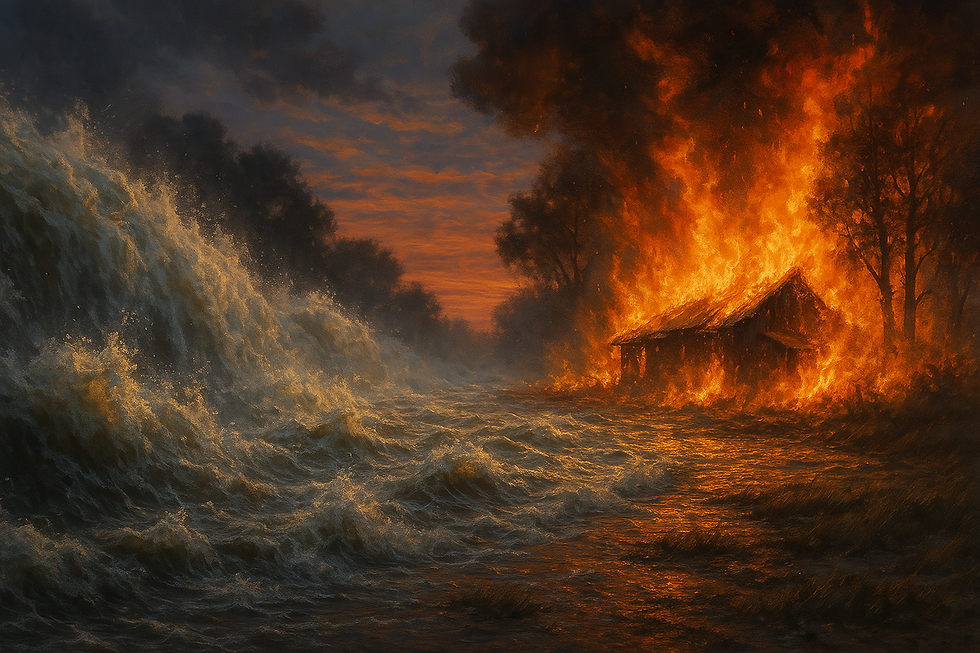
When we think of Black land loss, we often picture sharecropping scams or lynch mobs. But there’s another weapon that white power wielded against Black communities — water.
Across the 20th century, dozens of Black towns were not just dismantled — they were literally flooded by government projects under the name of "progress." Meanwhile, eminent domain — the state’s "legal" power to seize private land for public use — became a sledgehammer used to erase Black wealth, memory, and power.
This wasn’t environmental policy.
It was state-sponsored land theft.
Drowned Towns: Black Futures Sunk by Design
Entire Black towns were deliberately flooded to create lakes, reservoirs, and parks that disproportionately benefited white communities.1
These weren’t accidents. In fact, officials often chose Black towns over nearby white towns when selecting sites for dams and reservoirs. Black communities — having fewer legal resources and political representation — were seen as easier targets.
Famous examples include:
Oscarville, Georgia: A prosperous Black town destroyed to create Lake Lanier.2
Vanport, Oregon: Once the second-largest city in Oregon, housing many Black workers; it was suspiciously wiped out by "flooding" during an infrastructure failure that many today still call deliberate negligence.3
Seneca Village, New York: A Black and Irish settlement wiped away to create Central Park — long before the modern era, but setting the pattern for later displacement.4
Black families were offered pennies for their homes and businesses — if they were offered anything at all. Once underwater, the history, the deeds, the graves, and the memories were all gone.
Eminent Domain: Legalized Theft in Broad Daylight
Even outside of drowned towns, eminent domain was a powerful tool used to rob Black families of land.
After Reconstruction, Black landowners faced relentless government seizure campaigns under the excuse of "urban renewal," "highway construction," and "public development."5 These projects disproportionately bulldozed Black neighborhoods, shoving families into ghettos and stripping them of generational wealth.
The process was chillingly simple:
Declare a thriving Black neighborhood as "blighted" or "in need of improvement."
Use eminent domain to forcibly buy land at unfair, low-ball prices.
Destroy the community.
Rebuild for white businesses, suburbs, and industries.
Highways like I-75 in Detroit and I-10 in New Orleans ripped directly through Black communities, causing destruction that urban historians today compare to warfare.6
In the South, lakes and reservoirs became an additional weapon, one that left no visible trace of what was lost. Just a peaceful surface of water — hiding the ruins of Black prosperity underneath.
This Was No Mistake
When you flood Black land, when you erase Black towns, you erase:
Political power (no land, no votes).
Cultural memory (no markers, no museums).
Economic independence (no assets to pass down).
It’s a clean, quiet way to enforce racial capitalism without the messy optics of a lynching or a police riot.
And it worked. By the end of the 20th century, Black land ownership had plummeted by over 90%.7
That loss wasn't accidental. It was engineered!
Footnotes
Perry, Andre. Know Your Price: Valuing Black Lives and Property in America’s Black Cities. Brookings Institution Press, 2020.
Jeffries, Hasan Kwame. "The Racial Violence That Took Oscarville." The New Georgia Encyclopedia, 2018.
Burden, Dianne. "Vanport: The Flood That Wasn’t an Accident." Oregon Historical Quarterly, 2004.
Rosenzweig, Roy, and Elizabeth Blackmar. The Park and the People: A History of Central Park. Cornell University Press, 1992.
Fullilove, Mindy Thompson. Root Shock: How Tearing Up City Neighborhoods Hurts America, and What We Can Do About It. One World, 2005.
Mohl, Raymond A. "The Interstates and the Cities: The Highway Program and the Urban Crisis." Poverty and Race Research Action Council, 2002.
Newkirk II, Vann R. "The Great Land Robbery." The Atlantic, September 2019.
Drowned towns: What traces of 'ghost' cities lie beneath Alabama's man-made lakes?
Drowned Towns: How the US Has Strategically Flooded Historically Black Towns
“ The stories of four historically Black towns that are now underwater: Oscarville, Georgia, Kowaliga (Benson), Alabama, Vanport, Oregon, and Seneca Village in New York City. We'll take a look at how and why these fledgling towns were destroyed and the ripple effect it's had on Black Americans even today. “
FIRST TRIBE


Comments