

Before the Ships, Before the Chains Negro de Terra: Indigenous by Birth, Erased by Design

Updated: 6 days ago
By Ishmael A. Bey | FirstTribeNation
For generations, people now labeled Black, Negro, Colored, or Mulatto have been told that their presence in the Americas began with ships, chains, and colonial arrival. Yet a careful reading of artifacts, bones, and paper records tells a more complicated and more Indigenous story.
This article brings together material culture, anthropological scholarship, modern bioarchaeology, and colonial record analysis to demonstrate a simple but powerful truth:
Indigenous peoples of the Americas were never phenotypically uniform and many communities later reclassified as “Negro” were Indigenous peoples erased on paper, not newcomers to the land.
This is not speculation. It is documented history.

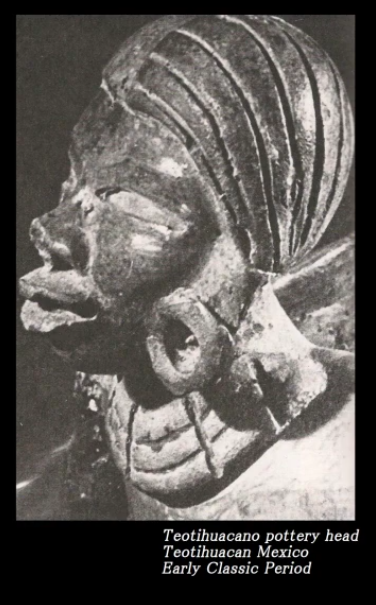
Teotihuacano Mexico pottery head early classic period pre-columbus era and modern computer re-created
I. Artifacts Speak: Alexander von Wuthenau and the Problem of the Human Face
In Unexpected Faces in Ancient America (1500 B.C.–A.D. 1500), Alexander von Wuthenau assembled one of the largest photographic collections of pre-Columbian portraiture ever published. His work focused on ceramic heads, figurines, and sculptural representations that displayed a wide range of human features some of which he identified as resembling African-descended populations.
What matters most about Wuthenau’s work is not whether one agrees with every conclusion, but what he preserved:
Close-up photographs of portrait heads meant to represent real people
Artifacts from multiple regions and cultures, not a single site
Objects housed in museums and documented private collections
These were not abstract gods or stylized symbols. Many were portrait forms, a genre intended to reflect lived human diversity.
What this proves: Ancient American artists depicted people with a broad range of facial structures, hair textures, and physiognomies undermining the myth of a single “Native look.”
What it does not prove: Artifacts alone do not establish migration routes or continental origins. They establish presence and diversity, not shipping manifests.
Used correctly, Wuthenau’s work functions as visual evidence of Indigenous plurality, not fringe diffusionism.


II. Bones Don’t Lie But They Must Be Read Carefully
Walter Neves and Early American Diversity
Modern bioarchaeology adds another layer of evidence. Brazilian anthropologist Walter Neves and his colleagues studied some of the earliest human remains in the Americas, particularly from the Lagoa Santa region of Brazil.
Their peer-reviewed research demonstrated that early American populations exhibited cranial diversity not fully consistent with later, narrower models of Native American morphology.
In plain language:
The first peoples of the Americas did not all look alike, and early populations showed physical variation that later became reduced or reshaped through time, migration, and population replacement.
What this proves:
Early American populations were biologically diverse
Rigid racial templates collapse under scientific scrutiny
What it does not prove:
Cranial morphology ≠ race
Morphology alone cannot define ethnicity, culture, or political identity
This is crucial, because modern genetics now confirms that race is a social classification, not a biological constant. Which brings us to the paper trail.
III. The Danger of Categories

Roland Burrage Dixon and Early Anthropology
To understand how Indigenous peoples became “Negro” on government forms, we must examine the era when race categories were codified.
Roland B. Dixon, a Harvard anthropologist of the early 20th century, represents a generation that attempted to systematize humanity into racial types. His work, now historically important but scientifically controversial , reveals how academic authority shaped government policy.
Dixon’s correspondence with W.E.B. Du Bois and his writings on racial history show anthropology operating not as neutral science, but as a tool of classification power.
Why this matters:
Census takers, school boards, and courts relied on these frameworks
Indigenous communities with darker skin or African-associated features were routinely reassigned to “Negro” categories
Once reclassified, land rights, treaty status, and tribal recognition evaporated
Dixon’s era teaches us this lesson clearly:
When race becomes bureaucracy, identity becomes confiscated.

IV. Language Is the Weapon
Jack D. Forbes and the Reclassification of Indigenous Peoples
No scholar documented this process more clearly than Dr. Jack D. Forbes.
In Africans and Native Americans: The Language of Race and the Evolution of Red-Black Peoples, Forbes demonstrated that terms like:
Negro
Mulatto
Colored
Mestizo
were not stable racial identities, but administrative labels that shifted depending on political need.
Forbes showed that many communities described as “Negro” in colonial and early American records were in fact:
Indigenous peoples absorbed into plantation economies
Detribalized nations stripped of legal standing
Survivors of wars, removals, and land seizures
In states like Virginia, this culminated in what historians now openly call “paper genocide” the systematic relabeling of American Indians as “colored” to eliminate their legal existence.
This is not metaphor. It is policy.

Ishmael Bey / FirstTribeNation: stitching the evidence into an Urban Indian sovereignty framework
V. From Archive to Action: FirstTribeNation Findings
FirstTribeNation
At FirstTribeNation, our work builds directly on this documented foundation.
We do not argue that all Black people are Indigenous. We demonstrate and prove that many Indigenous people were misclassified as Black.
Our research focuses on:
Census transitions where families shift from “Indian” to “Negro” in a single generation
Church, school, and tax records that preserve Indigenous continuity despite racial relabeling
Legal contradictions where communities are Indigenous in function but Negro in paperwork
We draw a critical distinction between:
Negro de Guinea (African origin)
Negro de Terra (Indigenous to the land, mislabeled)
This distinction existed historically. The state erased it.

Identical scarification of Ancient American Negro de Terra Artifacts and Modern African technique since Ancient time
VI. What the Evidence Actually Shows
When artifacts, bones, and paper are read together not cherry-picked the conclusion is unavoidable:
Ancient America was phenotypically diverse
Early anthropology hardened fluid identities into racial boxes
Colonial and U.S. governments weaponized those boxes
Indigenous peoples with darker skin were absorbed into “Negro” populations on paper
Modern descendants are now told their Indigeneity never existed
That is not history. That is erasure.

VII. Why This Matters Now
Recognition debates, land claims, and Urban Indian identity struggles are not abstract. They are the modern consequences of historical misclassification.
Restoration begins with truth.
Truth begins with documentation.
And documentation properly read says clearly:
Black Indigenous peoples did not disappear.
They were renamed.
American Moorish featured Artifacts showing Indigenous Origins


FIRST TRIBE


Comments