

A TRADE OF INDIANS

The Colonial Carolina Records That Expose a Forgotten American Indian Slave Trade

FIRST TRIBE Historical Research Institute
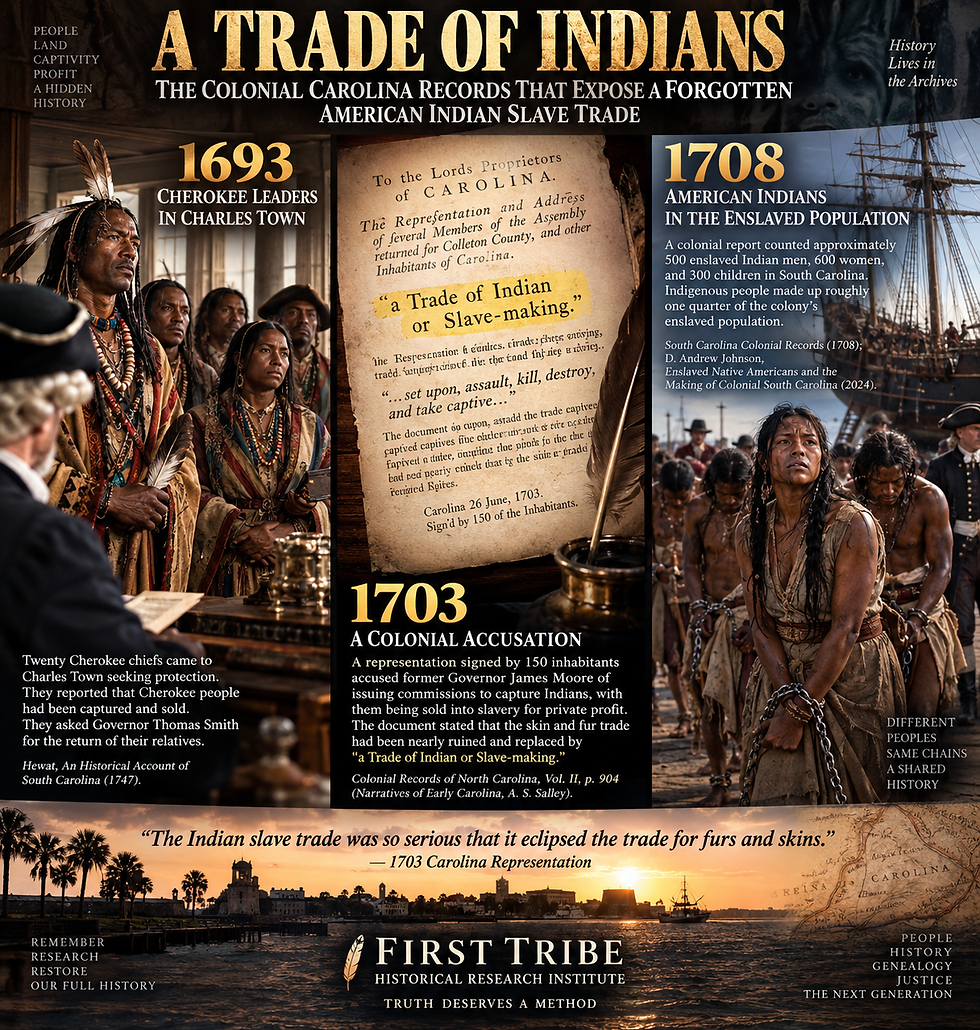
In 1693, according to one of the earliest histories of colonial South Carolina, twenty Cherokee leaders came to Charles Town asking for help.
They were not there simply to negotiate deer skins, territory, or military alliances.
They wanted their people back.
Alexander Hewat's eighteenth century history records that Cherokee towns had been attacked, Cherokee people had been taken prisoner, and some had been sold. The delegation asked Governor Thomas Smith for protection and requested the restoration of their relatives. Hewat reports that Carolina's growing trade encouraged Indigenous allies to bring captives into Charles Town, where captives could then be transported to the West Indies.

This episode forces us to confront a chapter of American slavery that is still frequently missing from popular conversation.
American Indians were being captured, sold, transported, and enslaved through Carolina decades before the United States existed.
And only ten years after that Cherokee delegation, a group of Carolina colonists produced an extraordinary document accusing one of the colony's most powerful men of helping transform the Indian trade itself into what they called:
“a Trade of Indian or Slave making.”
That phrase was written in 1703.
Not 1803.
Not during Indian Removal.
Not during the Civil War.
1703.
And the document survives.
June 26, 1703
On June 26, 1703, members of the Carolina Assembly from Colleton County and other inhabitants addressed a formal representation to the Lords Proprietors.
The petition was signed by 150 inhabitants.
The surviving printed version identifies it plainly:
“Carolina 26 June, 1703. Sign'd by 150 of the Inhabitants.”
The representation can be found in the historical collection Narratives of Early Carolina, 1650 to 1708, edited by Alexander S. Salley and preserved digitally by the Library of Congress. Modern scholarship also identifies the Colleton petition as having been signed on June 26, 1703.
What those Carolina inhabitants alleged deserves close attention.
They accused former Governor James Moore of interfering with regulation of the Indian trade for the benefit of himself and his associates.
According to the representation, the trade in skins and furs had been devastated and converted into a commerce based increasingly upon capturing Indians.
Then came an even more serious accusation.
The petitioners alleged that Moore had issued commissions to Anthony Dodsworth, Robert Mackoone, and others authorizing them to:
“set upon, assault, kill, destroy, and take Captive”
as many Indians as possible.
The petitioners alleged that proceeds from those enslaved captives were turned to Moore's private benefit.
Those are not the words of a twenty first century activist.
Those words appear in an early eighteenth century Carolina document.

Human beings had become part of the trade
The economic language of the document is chilling.
Carolina already maintained a substantial commerce with Indigenous nations involving deer skins, furs, weapons, manufactured goods, and other commodities.
But the 1703 petition accused the colony's political leadership of permitting something much darker to grow alongside that commerce.
Human beings were becoming commodities.
The document complained that the established trade in skins and furs was being transformed into a trade involving enslaved Indians and warned that the practice was spreading violence among Indigenous nations to the south and west of Carolina.
We should also be careful about what this document proves.
The 1703 representation is an accusation by Moore's political opponents, not a criminal conviction or judicial finding against him. The petition arose within a larger political battle involving elections, taxation, religion, government authority, and competing factions inside colonial Carolina. Historian Clarence Ver Steeg places the document squarely within that political conflict.
FIRST TRIBE therefore does not present every allegation in the petition as automatically proven merely because it was written down.
But neither can the document be dismissed.
Other evidence independently demonstrates that an extensive colonial trade in enslaved American Indians existed.
Carolina was already legislating the trade
The documentary trail moves beyond accusations.
Historian Almon Wheeler Lauber found that South Carolina imposed a duty on enslaved Indians exported from the colony in 1703. Traders were required to pay a fee for Indians they exported through Charles Town. He also documented colonial legislation governing the purchase and disposal of Indian captives taken during military expeditions.
Think about what taxation tells us.
Governments do not generally create export duties for imaginary commodities.
The presence of laws, duties, regulations, traders, purchasers, military captives, and overseas destinations demonstrates that Indigenous enslavement had become part of Carolina's colonial economy.
The practice had roots even earlier.
Lauber documents Carolina authorities permitting Indian captives to be sold following seventeenth century conflicts and describes captives being transported toward the West Indies. Proprietary officials sometimes attempted to restrict unauthorized enslavement while simultaneously allowing other forms of captive sale under colonial authority.
This was not a simple system.
It involved colonial officials, private traders, European imperial rivalries, Indigenous military alliances, Indigenous enemies, plantation labor demands, and an Atlantic market willing to purchase human beings.
The Cherokee appear on both sides of a changing world
This is where historical honesty matters.
FIRST TRIBE should not replace one simplified history with another.
Indigenous nations had traditions of warfare and captive taking before European colonization. But scholars emphasize that Indigenous captivity could involve adoption, incorporation, exchange, ritual, labor, or replacement of deceased community members. The expansion of European plantation economies created a powerful commercial market in which captives could instead be converted directly into money, goods, weapons, and plantation labor. Scholars describe that transformation as enormously disruptive to southeastern Indigenous societies.
American Indian nations also participated in capturing members of rival nations and selling captives into the colonial trade.
That fact must remain in the story.
But participation does not eliminate victimization.
A people can be drawn into a violent economic system while members of that same people are simultaneously being captured and sold through it.
The Cherokee record demonstrates precisely why simple slogans fail us.
According to Hewat, Cherokee leaders were asking Carolina authorities for assistance concerning enslaved Cherokee people in 1693. Later Cherokee groups also participated at various times in colonial warfare and captive taking.
Still later, particularly by the nineteenth century, some wealthy Cherokee families adopted plantation agriculture and enslaved African Americans. The National Park Service documents Cherokee plantations worked by enslaved Africans by the 1820s and identifies prominent Cherokee slaveholders.
All of those histories can be true simultaneously.
History does not require us to erase one in order to acknowledge another.

One quarter of South Carolina's enslaved population
Perhaps the most powerful evidence comes only five years after the 1703 petition.
In 1708, South Carolina's governor reported information concerning the colony's population.
The numbers included approximately:
500 enslaved Indian men
600 enslaved Indian women
300 enslaved Indian children
That is approximately 1,400 enslaved American Indians within the colony.
The same account listed approximately 4,100 enslaved Africans.
In other words, Indigenous people constituted approximately one quarter of South Carolina's enslaved population at that moment. Historian D. Andrew Johnson has brought renewed attention to this extraordinary statistic in his 2024 study Enslaved Native Americans and the Making of Colonial South Carolina. Smithsonian Libraries and Johns Hopkins University Press both describe his findings.
Pause there.
One out of approximately every four enslaved people in South Carolina in 1708 was American Indian.
Yet ask most Americans to picture slavery in early South Carolina and almost none will imagine an Indigenous woman, man, or child.
That historical disappearance is itself worthy of investigation.
How large was the trade?
No surviving ledger can tell us precisely how many Indigenous people were captured across the entire Southeast.
The records are incomplete, and substantial portions of the commerce went undocumented.
Historian Alan Gallay, whose major study The Indian Slave Trade: The Rise of the English Empire in the American South, 1670 to 1717 transformed scholarship on this subject, estimated that approximately 24,000 to 51,000 Indigenous people were enslaved through the southern Indian slave trade between 1670 and 1715.
That is an estimate, not an exact census.
But even the lower figure reveals a massive system involving thousands of Native lives. Gallay argues that Indian slavery was central to the political and economic development of the colonial Southeast rather than a marginal footnote to it.
Many captives were transported through Charles Town and sent elsewhere in the British Atlantic, including Caribbean plantation colonies.
Once people were exported, separated from their families, renamed, relocated, or absorbed into distant slave populations, reconstructing their descendants becomes enormously difficult.
That should matter to genealogists.
It should matter to historians.
And it should especially matter to descendants whose family histories later appear under racial classifications that tell us little about how their ancestors actually entered colonial society.
A historical correction within the historical discovery
There is also a lesson here about research itself.
James Mooney's important Smithsonian Bureau of American Ethnology work Myths of the Cherokee connected the 1693 Cherokee complaints with the later accusations against James Moore. Mooney described the Moore accusation as occurring in 1705.
Lauber also repeated the 1705 date in his influential study of Indian slavery.
But when we follow the citation backward and inspect the representation itself, something different appears.
The surviving document says:
June 26, 1703.
Modern historical scholarship likewise identifies the Colleton County petition as a June 1703 document.
This is exactly why FIRST TRIBE insists that Truth Deserves a Method.
Respect the historian.
Read the footnote.
Find the earlier source.
Then check it again.
A respected scholar can preserve an invaluable historical clue while still getting a date wrong.
Correcting that date does not weaken the history.
It strengthens it.

What the original Facebook post gets right, and what must be corrected
The social media post that led us into this investigation contains a real historical story.
Cherokee people were indeed victims of the colonial Indian slave trade.
A Cherokee delegation seeking protection is recorded for 1693.
A surviving Carolina representation accused former Governor James Moore and his associates of profiting from Indian slave taking.
The document really did describe the transformation of commerce into a “Trade of Indian or Slave making.”
But historical precision requires two corrections.
The man receiving the Cherokee delegation was Governor Thomas Smith, not a royal governor. Carolina remained under proprietary government in 1693.
And the surviving representation accusing Moore is dated June 26, 1703, not June 26, 1705.
There is another distinction.
The 1703 representation was not a Cherokee petition.
It was a Carolina political document signed by inhabitants of the colony.
We should therefore never quote its accusations and tell readers that those particular words came directly from Cherokee leaders.
That would turn legitimate history into mythology.
The authentic record is compelling enough.
Before the plantation story most Americans know
When Americans discuss slavery, the historical imagination usually begins with Africans transported across the Atlantic and eventually arrives at cotton plantations, abolition, the Civil War, and emancipation.
That history is indispensable.
But it is not the complete history of slavery in North America.
Before South Carolina became one of the great plantation societies built upon enslaved African labor, American Indians were also being captured, bought, sold, taxed, transported, and exported.
Modern scholarship increasingly recognizes their importance to the creation of colonial South Carolina itself. Johnson's recent research draws on more than 15,000 documentary references to enslaved people and argues that Native labor and knowledge were significant to the colony's economic and cultural development.
This does not diminish African American slavery.
It expands the historical record.
One history does not have to disappear for another to become visible.
The question descendants should be asking
If thousands of American Indians were taken from southeastern communities, carried into Charles Town, sold locally, shipped to Caribbean colonies, or absorbed into colonial slave populations, an extraordinary genealogical question follows:
What happened to their descendants?
Not every person classified centuries later as Black, Negro, Colored, or Mulatto was therefore American Indian. Such a conclusion would go far beyond the evidence.
But neither should historians assume that every person appearing under one of those classifications necessarily possessed only one ancestry.
The Indian slave trade gives us a documented historical mechanism through which Indigenous ancestry could enter populations later recorded under broad racial categories.
That possibility must be investigated family by family and record by record.
That is where genealogy begins.
Not with a predetermined racial conclusion.
With evidence.
The record was there
The most unsettling part of this history may be that it was never entirely lost.
The records existed.
The Cherokee delegation appeared in historical accounts.
The colonial petition survived.
The words “Trade of Indian or Slave making” survived.
The names of officials survived.
The legislation survived.
The 1708 population figures survived.
The Indian slave trade did not vanish because no documentation existed.
Much of it vanished from popular memory because later American narratives of race and slavery became organized around categories that left little room for remembering enslaved Indigenous people.
Today the archive gives us another opportunity.
Not to invent ancestors.
Not to replace African history with Indian history.
Not to romanticize Indigenous nations.
But to restore an American history that is large enough to contain all of its people.
In 1693, Cherokee leaders reportedly came seeking relatives who had been carried away.
In 1703, Carolina inhabitants condemned what they called a “Trade of Indian or Slave making.”
In 1708, approximately one quarter of the enslaved population counted in South Carolina was Indigenous.
Those three dates should change how we understand the early South.
The people were there.
The trade was there.
The documentation was there.
Now the history must be there too.
FIRST TRIBE Historical Research Institute
Truth Deserves a Method.


Comments